
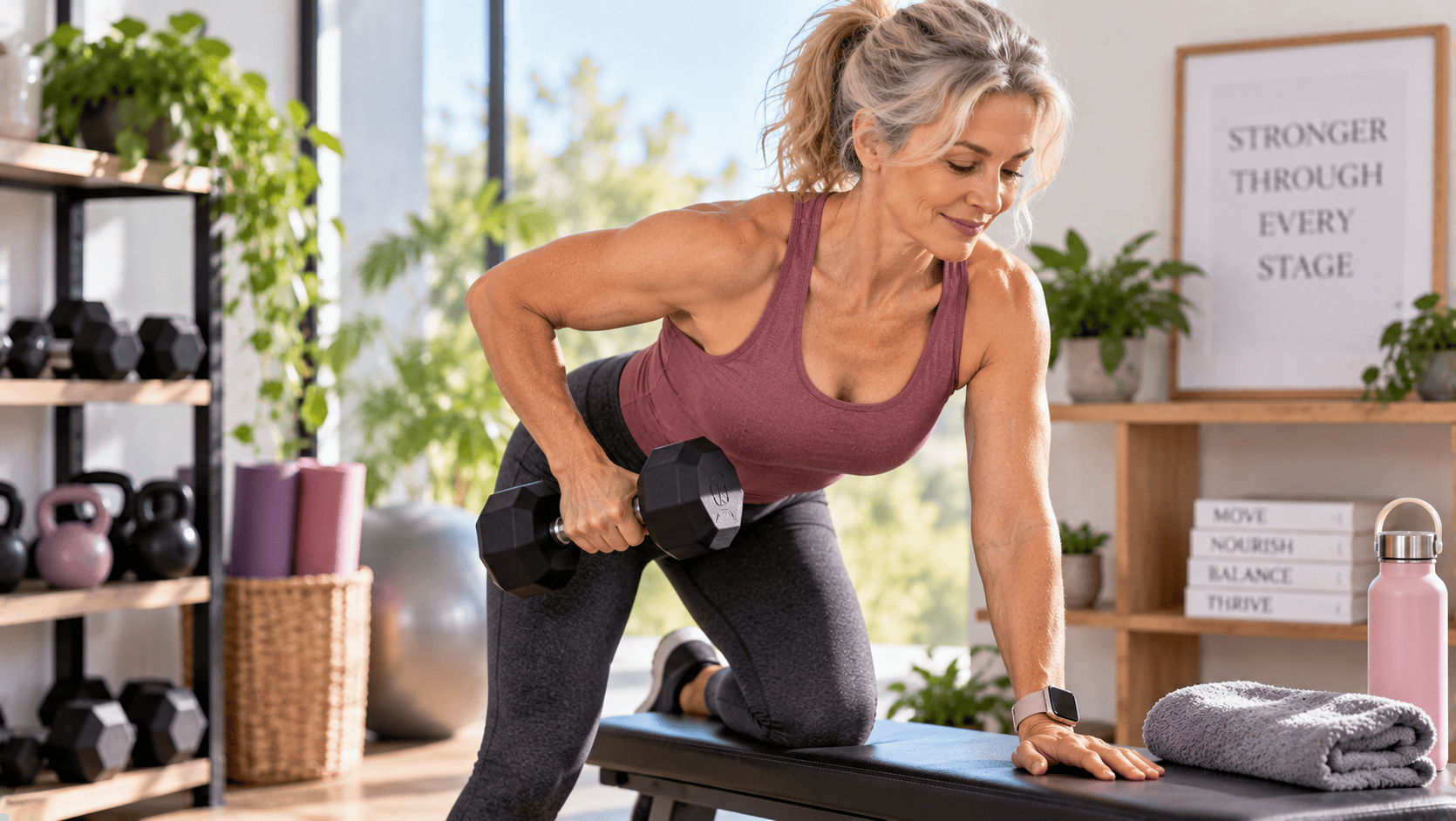
Strength training during menopause can help preserve and improve muscle strength, support bones, maintain mobility, and make everyday tasks easier. A good program does not need to be extreme. Training the major muscle groups at least twice a week, gradually increasing the challenge, eating enough nourishing food, and allowing time for recovery gives most women a practical foundation for staying strong through midlife and beyond.
Strength training during menopause should be considered alongside diet, movement, sleep, symptoms, medications, and individual medical needs. Decisions about strength training during menopause are most useful when they are personalized rather than based on a universal checklist. This evidence-focused overview considers practical use, limitations, and safety.
Strength training during menopause: Key Takeaways
- Menopause-related hormonal changes occur alongside normal age-related changes in muscle and bone health.
- Resistance training can improve strength and physical function in postmenopausal women.
- At least two muscle-strengthening sessions per week provide a practical starting point for most adults.
- Progress comes from gradually increasing resistance, repetitions, sets, range of motion, or exercise difficulty.
- Nutrition, sleep, recovery, and consistent training matter more than complicated workout plans or supplement stacks.
Why Strength Training Matters During Menopause
Menopause is a major biological transition, but it does not suddenly remove your ability to become stronger. Muscle continues to respond to training throughout adulthood.
The U.S. Office on Women’s Health explains that changes in estrogen, progesterone, and testosterone around menopause can affect muscle health and strength. Aging, activity level, nutrition, chronic disease, and previous exercise habits also influence how much muscle and strength change over time.
Resistance training directly challenges muscle to produce force. Over time, that challenge can improve strength, support physical function, and help maintain the ability to perform daily activities such as climbing stairs, carrying groceries, or getting up from a chair.
Menopause changes the context, not the basic principle: muscles still adapt when you challenge them regularly and give them enough nutrition and recovery.
What Does the Research Show?
A 2024 systematic review and meta-analysis of randomized trials found that resistance training improved upper- and lower-body strength in healthy postmenopausal women. The researchers also reported improvements in physical fitness, although findings for body composition and bone mineral density were less consistent.
An earlier systematic review also found improvements in functional capacity with resistance training. However, the authors rated much of the evidence as low or very low certainty, which means precise effects should not be overstated.
Research therefore supports strength training as a useful strategy while leaving room for individual differences. Training history, exercise selection, intensity, volume, recovery, and health status can all influence results.
How Often Should You Strength Train?
The National Institute on Aging and Office on Women’s Health recommend muscle-strengthening activity at least two days per week. Those sessions should collectively work the major muscle groups.
Two full-body workouts can therefore provide a realistic starting schedule. Some women prefer three sessions per week, and research in postmenopausal women has also used three-day programs successfully.
More training is not automatically better. A schedule only works when you can recover from it and continue it long enough to progress.
Simple starting point: Train the major muscle groups twice a week, leave recovery time between demanding sessions, and add more training only when you are recovering well.
The Main Movement Patterns to Train
You do not need dozens of exercises. A balanced routine can cover the body with a small group of movements that train major muscle groups.
- Squat or sit-to-stand: thighs, hips, and glutes
- Hip hinge: glutes, hamstrings, and back muscles
- Row or pulldown: upper back and arms
- Chest or overhead press: chest, shoulders, and arms
- Step-up or split squat: legs, hips, and balance
- Carry or controlled core exercise: trunk stability and whole-body strength
Dumbbells, machines, resistance bands, cable systems, kettlebells, and body-weight movements can all work. Choose equipment that lets you move with control and gradually increase the challenge.
A Simple Beginner Strength Workout
A beginner program can stay simple. Select one exercise from each major movement pattern and practice good technique before trying to maximize resistance.
| Movement | Beginner option | Possible progression |
|---|---|---|
| Squat | Chair sit-to-stand | Goblet squat |
| Hip hinge | Supported hip hinge | Dumbbell deadlift |
| Pull | Band row | Cable or dumbbell row |
| Push | Wall push-up | Incline or dumbbell press |
| Single-leg pattern | Low step-up with support | Split squat or higher step-up |
The Office on Women’s Health gives one set of 8–12 repetitions as a basic muscle-strengthening framework. Beginners can start there and add another set when technique feels comfortable and recovery remains manageable.
How Hard Should You Train?
Strength training should eventually feel challenging. If every set remains effortless for months, the muscles receive little reason to adapt further.
The National Institute on Aging advises using enough effort that completing another repetition becomes difficult near the end of a set. Beginners can build toward that level rather than forcing maximum effort immediately.
Technique still matters. Stop or modify an exercise when pain, dizziness, loss of control, or another concerning symptom appears. Normal muscular effort feels different from sharp or worsening joint pain.
Progressive Overload Without Overdoing It
Progressive overload simply means increasing the training challenge over time. It does not require adding weight at every workout.
- Use slightly more resistance.
- Complete another controlled repetition.
- Add a set when recovery allows.
- Improve your range of motion.
- Use better control and technique.
- Progress from a supported exercise to a less supported version.
Record your exercises, resistance, repetitions, and sets. A simple training log makes gradual improvement easier to see.
Does Training Volume Matter?
Training volume describes how much work you perform. Sets, repetitions, resistance, and frequency all contribute to it.
A 2024 analysis of resistance-training trials in postmenopausal and older women found that higher-volume programs may promote more whole-body muscle growth than lower-volume programs. That does not mean beginners should immediately perform a high-volume routine.
Start with enough training to create progress. Add volume gradually when you can complete your current workload with good technique and recover before the next session.
More work can help, but only when you can recover from it. The best training volume is not the largest amount you can survive for one week. It is an amount you can progress with consistently.
Strength Training and Bone Health
Bone health becomes an important concern around and after menopause. ACOG notes that strength training challenges muscles and bones, while weight-bearing exercise also supports skeletal health.
Not every strength routine produces the same bone stimulus. Loading, exercise selection, progression, and impact all matter. Recent research has explored heavier resistance and impact training for menopausal women, particularly for bone health, but individualization remains important.
If you have osteoporosis, previous fractures, or a high fracture risk, get guidance on safe exercise selection instead of copying a high-impact or heavy-lifting program designed for someone else.
Strength Training and Hot Flashes
Some studies have examined whether resistance exercise affects hot flashes and other vasomotor symptoms. Meta-analyses suggest a possible reduction in hot-flash frequency, but the evidence base remains much less certain than the evidence for strength and physical function.
Treat improved strength as the primary expected training benefit. If symptoms also improve, that can be welcome, but exercise should not be presented as a guaranteed treatment for hot flashes.
Protein and Strength Training During Menopause
Protein provides amino acids that the body uses to maintain and repair muscle tissue. Strength training supplies the signal that tells muscle to adapt.
Build meals around practical protein-rich foods such as fish, poultry, eggs, yogurt, milk, cottage cheese, tofu, tempeh, beans, lentils, nuts, and seeds. Plant and animal foods can both contribute to an effective eating pattern.
A protein powder can help when convenience or appetite makes food intake difficult, but it is not required for strength training to work.
Keep the priorities clear: resistance training provides the stimulus, while enough food and protein help support repair and adaptation.
Recovery Can Change During Menopause
Hot flashes, night sweats, sleep disruption, stress, and fatigue can make some training days feel different from others. A rigid program may therefore be less useful than one that allows sensible adjustments.
After a poor night of sleep, you might use slightly less resistance or perform fewer sets rather than skipping the entire week. When energy returns, resume normal progression.
Persistent fatigue, declining performance, worsening pain, or repeated difficulty recovering can signal that your program needs less volume, more recovery, or professional review.
Should You Still Do Cardio?
Yes. Strength training and aerobic exercise support different but overlapping areas of health.
Current activity guidance encourages adults to combine muscle-strengthening exercise with regular aerobic activity. Walking, cycling, swimming, hiking, or other enjoyable movement can support cardiovascular fitness while strength work gives muscles a more direct training stimulus.
You do not need to choose between cardio and lifting. A balanced week can include both.
Do You Need Special Menopause Exercises?
There is no separate set of magical “menopause exercises.” The basic principles of strength training still apply: train major muscle groups, use enough resistance to create a challenge, recover, and progress over time.
What may change is how you apply those principles. Joint symptoms, pelvic-floor concerns, osteoporosis, previous injuries, training experience, sleep quality, or other health conditions can affect exercise choice and progression.
Individualization matters more than attaching a menopause label to a particular workout.
What About Heavy Strength Training?
Women do not need to avoid challenging resistance simply because they are in menopause. Research includes programs using substantial resistance, and a 2026 systematic review found that high-intensity resistance and impact exercise has been studied in peri- and postmenopausal women.
However, “heavy” is relative to the person. A beginner should first learn the movement, build confidence, and develop tolerance before progressing to heavier loads.
Women with osteoporosis, fractures, significant joint problems, or other medical concerns may need professional guidance before using high loads or impact exercise.
Common Strength-Training Mistakes During Menopause
Staying With the Same Light Weights Forever
Light resistance can be an excellent starting point. Once it stops feeling challenging, gradually increase the difficulty if continued strength improvement is the goal.
Changing Workouts Too Often
Constant exercise changes make progress difficult to measure. Keep core movements long enough to practice them and track improvement.
Using Soreness as the Goal
Muscle soreness can occur after training, especially after a new exercise. It does not measure workout quality. Progress, technique, and consistency provide better feedback.
Doing Only Cardio
Walking and cardio remain valuable, but they do not fully replace the specific muscle-strengthening stimulus of resistance exercise.
Expecting a Supplement to Replace Training
Protein powders, creatine, collagen products, and vitamins may serve specific purposes, but none replaces progressive resistance training.
When to Get Individual Guidance
Many women can begin with simple strength exercises and gradual progression. Certain situations deserve more individualized guidance from a healthcare professional, physical therapist, or qualified exercise professional.
- You have osteoporosis, a recent fracture, or a high fracture risk.
- Chest pain, unexplained shortness of breath, fainting, or dizziness occurs with activity.
- Joint or back pain limits normal movement.
- You have significant balance problems or recurrent falls.
- A medical condition or recent surgery changes which exercises are appropriate.
Frequently Asked Questions
Related reading
The Bottom Line
Strength training during menopause is one of the most practical ways to support muscle strength, physical function, mobility, and healthy aging. Two well-planned sessions each week can provide a strong starting point, while some women may benefit from additional training as experience and recovery improve.
Focus on the major muscle groups, use resistance that gradually becomes challenging, eat enough nourishing food, and allow time to recover. You do not need a menopause-specific exercise trick. Consistent progressive training remains the foundation.
Medical disclaimer
Medical disclaimer: This content is for educational and informational purposes only and is not a substitute for professional medical advice, diagnosis, or treatment. Dietary needs and supplement suitability vary by individual.
Authoritative women’s health resources: Office on Women’s Health — Menopause and NIH Office of Dietary Supplements fact sheets.
Sources
- U.S. Department of Health and Human Services, Office on Women’s Health. Sarcopenia and Menopause. 2025.
- U.S. Department of Health and Human Services, Office on Women’s Health. Strength Training at Home. 2025.
- National Institute on Aging. Three Types of Exercise Can Improve Your Health and Physical Ability. Updated 2025.
- American College of Obstetricians and Gynecologists. The Menopause Years. Accessed September 2026.
- González-Gálvez N, Moreno-Torres JM, Vaquero-Cristóbal R. Resistance training effects on healthy postmenopausal women: a systematic review with meta-analysis. Climacteric. 2024;27(3):296-304.
- Sá KMM, da Silva GR, Martins UK, et al. Resistance training for postmenopausal women: systematic review and meta-analysis. Menopause. 2023;30(1):108-116.
- Nunes PRP, Kassiano W, Castro-E-Souza P, et al. Higher volume resistance training enhances whole-body muscle hypertrophy in postmenopausal and older females: a secondary analysis of systematic review and meta-analysis of randomized clinical trials. Archives of Gerontology and Geriatrics. 2024;124:105474.
- Tortoli E, Riccio G, Mattii E, et al. High-intensity resistance and impact exercise in menopausal women: a systematic review of intervention reporting quality and training content. Osteoporosis International. 2026.
