
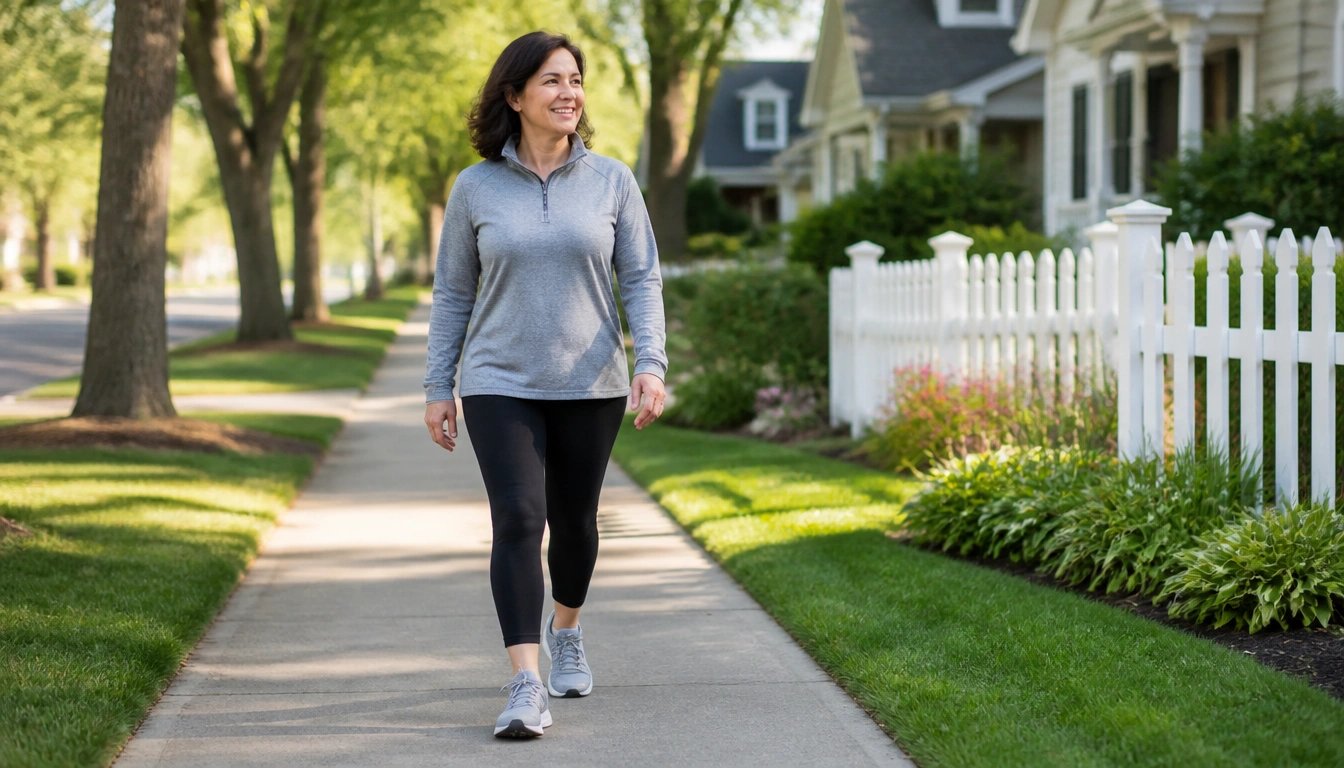
Start with a walking plan for consistency, not intensity. For a complete beginner, that usually means very short walks you can repeat: 10 to 12 minutes, three days a week, at an easy pace. Build the habit first, then increase time and pace gradually. If you can talk but not sing, you are likely in a moderate-intensity zone. Stop if you get chest pain, severe shortness of breath, dizziness, or sharp joint pain.
Key Takeaways
- Consistency matters more than starting hard. A small, repeatable plan is more useful than an ambitious plan you quit.
- A beginner-friendly start can be 10 to 12 minutes, three days a week, then a gradual increase over several weeks.
- Use the talk test: you should be able to talk comfortably during a moderate walk, but not sing.
- Simple tools like habit stacking, a calendar checkmark, and an indoor backup plan make walking easier to sustain.
- Mild muscle fatigue is common, but sharp joint pain, swelling, chest pain, dizziness, or severe breathlessness needs attention.
Why consistency matters more than intensity at the start
For absolute beginners, the biggest win is moving from none to some. Public health guidance from the CDC and other major health authorities supports regular aerobic activity, but the first step is not proving you can do a long walk on day one. It is showing your body and your schedule that walking can happen again and again.
That is why a walking plan for consistency should begin smaller than many people expect. Ten minutes of walking is not “too little” if it helps you avoid burnout, protects sore joints, and builds trust in the routine. A short walk done three times a week is more valuable than a hard first week that leaves you tired, discouraged, or sore enough to stop.
Think of the first phase as practice for the habit. You are training your calendar, your shoes, and your mindset as much as your legs and heart. If you can leave the house, move for a few minutes, and come back feeling like you could repeat it tomorrow, you are on the right track.
How to know you are walking at the right effort level
The simplest way to judge moderate intensity is the talk test. During a moderate walk, you should be able to talk in full sentences, but you should not be able to sing. Your breathing should be deeper, your heart rate should rise, and you may feel warmer, but the effort should still feel controlled.
For a new walker, that often means starting at a comfortable pace and only gradually moving toward brisk walking. A brisk walk is not a race. It is a pace that feels purposeful and steady, with a little more breathing effort than a casual stroll. If your form becomes strained or you need to stop frequently to catch your breath, the pace is probably too high for the moment.
If you are unsure, use effort rather than speed. Your pace may look different from someone else’s, and that is normal. The right pace is the one you can repeat safely, recover from well, and come back to the next scheduled day.
A four-phase beginner walking progression
Start with a plan that respects your current baseline. This version is designed to turn walking into a repeatable routine before asking your body for longer sessions. If a phase feels too easy, that is not a problem. Ease at the beginning is often what makes consistency possible.
Phase one: make the habit visible
Walk three days a week for 10 to 12 minutes total. Keep the pace easy. You can walk out for five or six minutes and turn around, or walk a short loop near home. The goal is to complete the session, not to feel challenged.
Phase two: add a little more time
Move to four days a week and 15 to 20 minutes total. Stay easy for the first half, then gently increase your pace on the return portion if you feel ready. You should still be able to talk comfortably.
Phase three: introduce brief brisk sections
Try four to five days a week for 20 to 25 minutes. Begin with a five-minute easy warm-up, then alternate normal pace with short brisk segments, and finish with a slower cool down. This is a simple way to build fitness without turning every walk into a hard workout.
Phase four: reach a steady baseline
Work toward 30 minutes on most days of the week. By now, some part of the walk can feel brisk and controlled. Public health guidance commonly points to 150 minutes of moderate-intensity activity per week, and accumulated walking sessions count toward that target.
If 30 minutes at once still feels like too much, keep the time split. Two 15-minute walks can be easier on the body and just as useful for building the habit.
How to make the plan stick with habit stacking and tracking
Motivation is helpful, but routines usually survive because they are attached to something you already do. This is called habit stacking. Pair your walk with a reliable cue such as morning coffee, lunch, finishing work, or the end of dinner cleanup. The cue matters because it reduces decision-making.
Tracking should be simple. Use a paper calendar, a notes app, or a basic step counter to mark the days you walk. You are not trying to create pressure. You are trying to make progress visible. Seeing a chain of completed days can be encouraging in a way that memory alone is not.
A second support is planning the next walk before the current one ends. Decide where you will walk, when you will go, and what you will wear. When the next step is already chosen, it is easier to follow through on a low-energy day.
It also helps to lower the barrier to starting. Keep shoes near the door. Choose clothes the night before. If the goal is only 10 minutes, the mental load stays small enough that you are less likely to negotiate yourself out of it.
What to do when life gets in the way
Weather, unsafe routes, fatigue, and busy days are part of real life. A consistent walking habit needs backup plans, not perfect conditions. If it is too hot, icy, dark, or unsafe outside, switch to an indoor option instead of skipping the session entirely.
Indoor walking can be very practical. Options include a treadmill, an indoor track, walking laps in a mall, or simply pacing indoors in short blocks. If needed, split the walk into two or three smaller sessions across the day. Accumulated movement still counts, and smaller sessions are often easier to protect on crowded days.
If you miss a day, do not “make up” for it with a much harder workout. Just return to the next scheduled walk. Consistency comes from resuming the routine quickly, not from trying to compensate dramatically.
When weather or safety is a regular barrier, plan your default indoor route in advance. That reduces the chance that one bad day turns into a lost week.
How to adjust for older adults or people with joint stiffness
Older adults and people with stiff knees, hips, ankles, or feet often do better with flatter surfaces, shorter durations, and slower progress. That is not a sign of weakness. It is a sensible way to reduce impact and preserve confidence. Flat sidewalks, indoor tracks, and treadmills with stable handrails can be useful options.
Footwear matters here. Supportive, comfortable shoes that fit well can reduce friction and make walking feel more stable. If balance is a concern, choose routes with fewer obstacles, better lighting, and places to rest if needed.
If your joints feel stiff at the start of a walk, a gentle warm-up pace for the first few minutes can help. It is also reasonable to keep the early phases shorter than the plan suggests and progress more slowly. You do not need to match someone else’s timeline. You need a plan you can repeat without flaring symptoms.
People with chronic conditions such as heart disease, diabetes, or significant arthritis should use individualized medical advice when needed. A healthcare professional can help tailor the starting point and progression to your situation.
Safety checks: normal soreness versus warning signs
Some mild muscle fatigue or general stiffness can be normal when you begin a new routine. That usually improves as your body adapts. Normal adaptation tends to feel broad, mild, and manageable, rather than sharp or sudden.
Stop walking and reassess if you get sharp or localized joint pain, swelling, or tendon pain that keeps coming back. Rest, reduce the next session, and pay attention to whether the discomfort improves. If pain worsens with each walk, that is a sign to slow down rather than push through.
Seek medical attention right away for chest pain, pressure, tightness, or discomfort in the chest, neck, jaw, or arms. Also stop and get help if you have sudden dizziness, faintness, or severe shortness of breath. Those are not normal training signals.
As a general rule, discomfort that changes your gait, makes you limp, or feels sharp enough to make you alter the walk deserves caution. The goal is to build a habit, not to create a problem that keeps you from the next session.
When to get medical clearance before starting
If you have been sedentary for a long time, have a diagnosed heart, lung, or metabolic condition, or have unexplained symptoms with light exertion, it is sensible to talk with a healthcare professional before starting a new walking routine. The same is true if you are unsure how your medications, balance, or joint issues might affect safe walking.
Medical clearance is especially useful when your situation is not straightforward. That might include recent illness, chest symptoms, falls, dizziness, or a history of exercise-related problems. A clinician can help you decide whether to start with shorter walks, a slower pace, or a different level of supervision.
For many healthy beginners, walking is a low-risk way to begin moving again. Still, asking for advice when you have medical concerns is a strength, not an overreaction. It can help you start with more confidence and less guesswork.
Frequently Asked Questions
How many minutes should a total beginner walk each week?
A useful starting point can be as little as 10 to 12 minutes, three days a week. From there, build toward more frequent and longer walks. Public health guidance commonly points toward 150 minutes of moderate-intensity activity per week, but beginners do not need to start there on day one.
What pace counts as a moderate or brisk walk?
A moderate or brisk walk is one where your breathing is deeper and your heart rate is up, but you can still talk comfortably. If you can sing, the pace is probably too easy to count as moderate. If you cannot speak at all, it may be too hard for a beginner walk.
How do I build up from 10 minutes to 30 minutes safely?
Increase gradually in phases. Start with 10 to 12 minutes, three days a week, then add time and one extra day before moving to brisk intervals. If your joints feel strained or you feel wiped out after sessions, stay at the current level a little longer before progressing.
What should I do if I can only walk indoors or in bad weather?
Use an indoor option instead of skipping the walk. A treadmill, mall, indoor track, or even short walks around your home can work. You can also split one walk into two smaller sessions. Consistency matters more than doing it outdoors.
When should I stop walking and seek medical advice?
Stop and seek medical help for chest pain, pressure, jaw or arm discomfort, sudden dizziness, faintness, or severe shortness of breath. Also get advice if you have persistent sharp joint pain, swelling, or symptoms that get worse each time you walk.
The Bottom Line
The best walking plan for consistency is the one you can repeat. Start smaller than you think, use the talk test to keep the effort in a manageable range, and build time gradually instead of trying to jump straight to long walks.
Make the habit easier to keep by linking it to a daily cue, tracking it simply, and having indoor backups for bad weather or unsafe routes. If your joints are stiff, choose flatter surfaces and shorter sessions so the routine stays sustainable.
If you have medical conditions, unexplained symptoms, or warning signs like chest pain or severe shortness of breath, get medical advice before pushing ahead. The goal is steady progress, not forcing your way through pain.
Medical disclaimer
Medical disclaimer: This content is for educational and informational purposes only and is not a substitute for professional medical advice, diagnosis, or treatment. Dietary needs and supplement suitability vary by individual.
Sources
- National Health Service (NHS) — www.nhs.uk. Accessed October 2026.
- Centers for Disease Control and Prevention (CDC) — cdc.gov. Accessed October 2026.
- National Health Service (NHS) — www.nhs.uk. Accessed October 2026.
- National Health Service (NHS) — westlondon.nhs.uk. Accessed October 2026.
- National Health Service (NHS) — royalberkshire.nhs.uk. Accessed October 2026.
- Academic / Medical Research Institution — heart.org. Accessed October 2026.
