
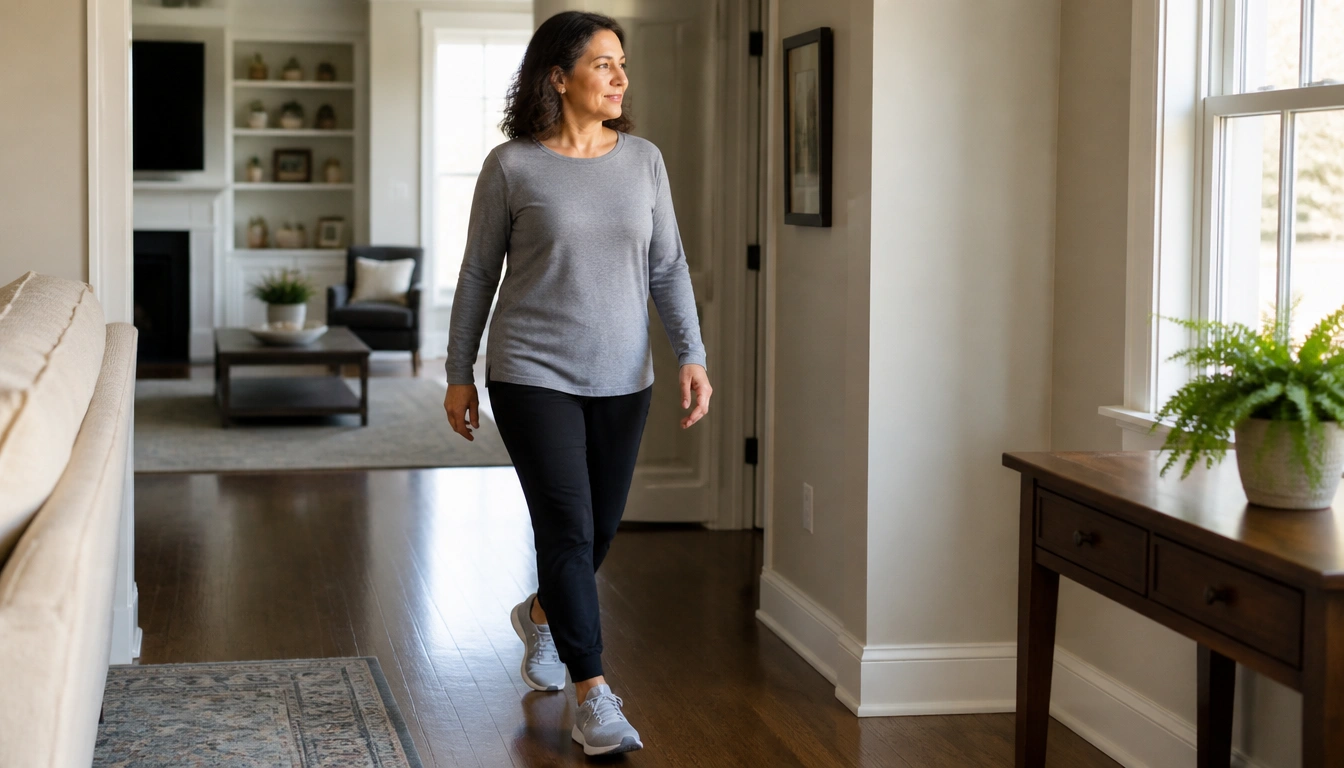
A realistic walking plan for consistency at home usually starts smaller than people expect. If 30 minutes feels hard, begin with 10 minutes a day, anchor it to an existing routine, and build up gradually. Short walks done at home still count toward weekly aerobic goals when they add up to enough total moderate activity, especially if the pace is brisk enough to warm you up and raise your breathing without making it hard to talk.
Key Takeaways
- Start with a 10-minute daily baseline if a full 30-minute walk feels unrealistic; consistency matters more than perfection at first.
- Brisk walking at home should feel warmer and faster-paced, with breathing that is deeper but still allows conversation.
- You can split walking into shorter bouts across the day and still support weekly aerobic activity goals.
- A gradual progression from 10 to 15 minutes, then 20, then 30 minutes can reduce overload and improve follow-through.
- Home barriers like limited space, schedule blur, and foot fatigue are easier to manage with habit stacking, indoor pacing loops, and supportive shoes.
Why a smaller walking plan often works better at home
For home exercisers, the hardest part is usually not the walk itself. It is starting when your workday, family time, and rest time all happen in the same space. That is why a walking plan for consistency should begin with a goal you can repeat, not a goal that sounds ideal on paper.
Public health guidance from the CDC and the U.S. Department of Health and Human Services supports adults working toward at least 150 minutes of moderate-intensity aerobic activity each week, such as brisk walking. But that target does not have to be reached all at once. A walk that happens regularly is more useful than a longer plan you keep missing.
At home, brisk walking has a simple feel: you are warmer, your breathing is faster, and you can talk, but you cannot sing. That self-check is practical when you do not have a smartwatch or treadmill display. If you can speak in full sentences without gasping, you are probably in the right neighborhood for moderate intensity.
Walking also works well because it is easy to adjust. On low-energy days, you can do less. On better days, you can do more. That flexibility matters for consistency.
Start with a 10-minute baseline you can repeat
If 30 minutes feels too big, begin with 10 minutes. Ten minutes is short enough to fit into a busy day, but long enough to become a real habit instead of a vague intention. A daily baseline also lowers the mental friction that often stops home exercise before it starts.
Pick one anchor you already do most days. For example: after morning coffee, after you log off work, after lunch, or while a certain podcast starts. The walk becomes easier to remember when it is attached to something automatic.
Keep the first version simple. Put on shoes, move for 10 minutes, and stop. The goal is not to prove fitness in one session. The goal is to create a repeatable pattern your brain begins to expect. If you can consistently do 10 minutes, you are in a much better position to grow the habit later.
If indoor space is tight, pacing a hallway, walking laps around a room, or moving between two points in the home can work. The path does not need to be elegant; it only needs to be safe and easy to repeat.
Build up from 10 to 30 minutes without overloading yourself
A gradual increase helps your body and your schedule adjust together. One workable progression is to spend the first one to two weeks doing 10 to 15 minutes of brisk walking on four days each week. Then move to 20 minutes on four to five days each week. After that, increase toward 30 minutes on five days each week, or split the time into two shorter walks.
This approach is useful because many people do not fail from lack of motivation alone; they fail because the first plan is too demanding for their current routine. By building in stages, you give your legs, feet, and attention span time to adapt.
Short bouts count, too. If your day is interrupted, three 10-minute walks can still support your weekly aerobic goal. That flexibility is one reason walking works so well for people at home, especially when work meetings, family needs, or weather break up the day.
A practical weekly pattern might look like this: one 10-minute walk before work, one after lunch, and one after dinner. Another day might allow a single longer walk. The point is the weekly total, not whether every session looks identical.
Use home cues to make walking automatic
At home, the best walking habits are usually attached to things that already happen without much thought. This is called habit stacking, and it can be more effective than relying on motivation alone. Examples include walking right after brushing your teeth, pacing during a phone call, or starting a walk as soon as you close your laptop.
Calls, podcasts, and audiobooks can be useful cues because they give the walk a job. Instead of thinking, “I should exercise,” you think, “This is my listening time.” That makes the walk feel less like an extra task and more like part of the day.
If you have a treadmill, it can be a good option for bad weather or late-day safety concerns. If not, an indoor pacing route can still work. Try a loop that avoids clutter, sharp corners, and slippery floors. A simple route you use often is better than a fancy plan you rarely use.
For people who work from home, it can help to define a clear start and stop. For example, a short walk after a meeting can become the boundary between work and the rest of your day. That can make the routine feel more natural and less forced.
Set up your space so the walk feels easy to begin
Consistency improves when the walk starts with fewer barriers. Keep walking shoes near the door or next to your desk so you do not have to search for them. Even at home, supportive footwear can reduce foot fatigue and make it easier to repeat the routine on consecutive days.
Choose a space that is safe and predictable. Clear loose rugs, pet toys, cords, or anything that could catch your foot. If you walk indoors, make sure the route has enough room to turn comfortably. Good lighting matters too, especially early in the morning or in the evening.
Timing also matters. Some people walk better before they sit down for the day, while others need a short reset after work. There is no single best time. The best time is the one you are most likely to keep.
If foot or joint discomfort is common, it may help to start with a softer surface, shorter bouts, and a pace that feels controlled rather than hurried. The aim is to make the routine sustainable, not punishing.
How to adjust the plan if you are older
Older adults can absolutely use walking as a home-based fitness tool, but the setup should support balance and confidence. Flat routes, stable footwear, and clear walkways are especially useful. A familiar indoor loop can be better than an uneven outdoor path on days when balance feels less steady.
Pay attention to foot placement, posture, and any tendency to rush. If the route includes stairs, tight turns, or slippery flooring, simplify it. The safest plan is the one that reduces the chance of a stumble.
It can also help to break walking into shorter sessions across the day. That approach often feels easier on the joints and still contributes to the weekly activity total. If you have a history of falls, new balance problems, or joint pain that changes your gait, speak with a healthcare professional about the safest way to progress.
For older adults, consistency should never come at the expense of stability. A slightly shorter walk done well is preferable to a longer one that leaves you feeling unsteady.
How to adjust the plan during pregnancy or after birth
Walking is often a practical form of activity during pregnancy and after birth, as long as the effort is kept moderate and comfortable. The best guide is how the body feels from day to day. Brisk does not have to mean hard. You should still be able to talk while walking.
Pregnancy and postpartum recovery can change energy levels, balance, and heat tolerance. Avoid overheating, drink fluids as needed, and adjust the pace on tired days. A shorter, gentler walk can be a better choice than trying to force your usual routine.
After birth, return gradually and follow medical advice if you had complications, surgery, or pelvic floor symptoms. If a walk causes pain, pressure, bleeding that concerns you, or a sense that something is not right, stop and ask a clinician for guidance. A walking plan should support recovery, not strain it.
Know when to pause and get medical advice
Walking is generally low risk, but it is still exercise. Stop and seek medical advice if you develop chest pain, severe shortness of breath, dizziness, faintness, or sudden sharp pain in a joint or muscle. These symptoms should not be brushed off as normal effort.
It is also wise to check in with a healthcare professional before increasing your walking plan if you have been inactive for a long time or if you live with a condition such as heart disease, diabetes, severe arthritis, or another issue that may affect exercise safety. The right plan can still be walking-based, but it may need individual adjustments.
If a plan keeps failing, that is not a character problem. It may mean the pace is too aggressive, the timing is wrong, or the environment needs to change. Use the next easier version rather than quitting altogether.
For most people, the safest progression is steady, repeatable, and boring in the best way. That is usually what makes it stick.
Frequently Asked Questions
How much walking do adults need each week for health benefits?
Public health guidance from the CDC and the U.S. Department of Health and Human Services recommends at least 150 minutes of moderate-intensity aerobic activity each week for adults. Brisk walking is one of the easiest ways to meet that goal, and you can build toward it gradually.
What counts as brisk walking intensity at home?
A good self-check is that you feel warmer, your breathing is faster, and you can still talk, but you cannot sing. If you can only breathe comfortably at a very easy pace, you may need to speed up a little. If you cannot speak in short phrases, you may be going too hard.
Can short 10-minute walks count toward weekly exercise goals?
Yes. Walking in shorter bouts can still count toward your weekly total as long as the activity is moderate intensity and the minutes add up. Three 10-minute walks across the day can be a practical way to reach your goal when one continuous session is hard to fit in.
How can I make a walking habit stick when I work or spend most of the day at home?
Tie the walk to something you already do, such as logging off work, finishing lunch, or starting a podcast. Keep the route simple, keep shoes handy, and decide in advance when the walk happens. The less you have to think about it, the easier it becomes to repeat.
When should I stop walking and get medical advice?
Stop and get medical advice if you have chest pain, severe shortness of breath, dizziness, faintness, or sudden joint or muscle pain. You should also check with a healthcare professional before increasing your plan if you have been inactive for a long time or have a medical condition that could affect exercise safety.
The Bottom Line
A home walking plan works best when it is small enough to repeat on ordinary days. Starting with 10 minutes, then building toward 20 and 30 minutes, gives you a realistic path toward the weekly activity goal without making the routine feel overwhelming.
Use the same tools that support other habits at home: a consistent cue, a clear route, supportive shoes, and a pace that feels brisk but controlled. If your day gets interrupted, shorter bouts still count and can keep the habit alive.
If symptoms feel unusual, if pregnancy or older age changes your balance or recovery, or if you have a medical condition that affects exercise, get individualized advice. The safest walking plan is the one you can keep doing comfortably and regularly.
Medical disclaimer
Medical disclaimer: This content is for educational and informational purposes only and is not a substitute for professional medical advice, diagnosis, or treatment. Dietary needs and supplement suitability vary by individual.
Sources
- National Health Service (NHS) — www.nhs.uk. Accessed November 2026.
- National Institutes of Health (NIH) — nih.gov. Accessed November 2026.
- Centers for Disease Control and Prevention (CDC) — cdc.gov. Accessed November 2026.
- National Health Service (NHS) — humberrecoverycollege.nhs.uk. Accessed November 2026.
- Academic / Medical Research Institution — heart.org. Accessed November 2026.
