
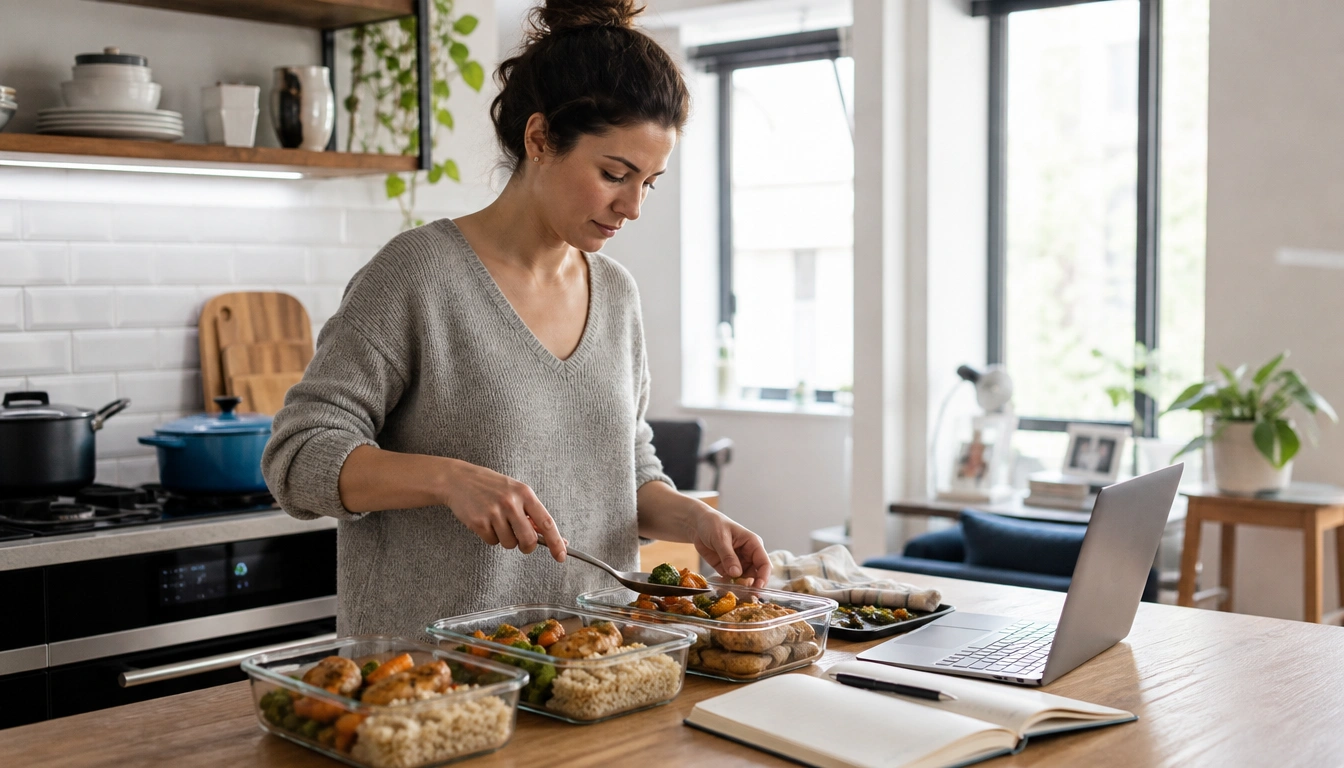
A realistic weekend meal-prep habit for people working from home starts with a short plan: choose a few lunches or dinners, batch-cook versatile ingredients, portion them safely, and store some in the fridge and some in the freezer. The goal is not a perfect menu. It is to make weekday meals easier, safer, and less tied to screen-time snacking.
Key Takeaways
- Keep the plan small enough to repeat: a few lunches, a couple of dinners, or modular ingredients is usually more sustainable than cooking every meal.
- Use meal prep to reduce decision fatigue and desk-side grazing by making the next meal easy to grab before the workday gets busy.
- Follow food-safety timing closely: cool cooked food within 1 to 2 hours, refrigerate promptly, and freeze portions you will not eat soon.
- Choose sturdy ingredients that still taste good later in the week, and store sauces or dressings separately when possible.
- People with diabetes, kidney disease, cardiovascular disease, or other medical conditions may need a more individualized meal plan than a generic template.
Why remote work makes meal habits harder
Weekend meal prep for people working from home works because remote work removes a lot of the structure that used to shape eating. There is no commute to separate meals from work, no cafeteria line to guide choices, and no natural reminder to step away from the desk. That makes it easier to graze on snacks, eat while answering emails, or postpone lunch until you are overly hungry and ready for whatever is fastest.
A weekend prep habit helps by doing some of the weekday thinking in advance. Instead of asking, “What should I eat?” several times a day, you decide once, shop once, and cook once. That does not mean every meal must be planned. It means you create a few reliable options so workdays feel less chaotic and less dependent on willpower.
Build a simple WFH meal-prep framework
The most useful systems are usually the simplest ones. Start by choosing how many meals you truly need. Some remote workers only want lunch; others want lunch and one dinner to make the week feel lighter. A realistic plan is better than an ambitious one that leaves you tired and resentful by Sunday night.
Then move through a basic sequence: plan, shop, batch-cook, portion, and store. Planning means checking your calendar for busy days and choosing meals that fit them. Shopping means buying enough ingredients for the number of portions you will actually use. Batch-cooking means preparing a few components at once, such as grains, vegetables, and a protein. Portioning means putting food into containers right away so weekdays do not turn into guesswork. Storage means deciding what should stay in the fridge and what should be frozen for later.
This framework is especially useful for remote work because it also lowers screen-based eating. If your lunch is already packed, you are less likely to keep nibbling through meetings or eat from a bag of snacks without noticing. The point is not rigid control; it is making the easiest option a better one.
Choose meals that support steady energy
For most healthy adults, the most satisfying meal-prep pattern follows a balanced plate approach. A practical version is to build meals around vegetables, a source of protein, and a fiber-rich carbohydrate such as whole grains, beans, lentils, or starchy vegetables. Healthy fats from foods like avocado, nuts, seeds, olive oil, or fatty fish can add staying power and flavor.
That kind of structure supports steadier energy than a lunch built mostly from refined carbs or snack foods. It also tends to be more filling, which matters when you are working from home and can easily drift back to the kitchen. Public health guidance from the CDC and other nutrition authorities consistently favors more fiber-rich, minimally processed foods and less added sugar, saturated fat, and sodium.
If you like a shortcut, think in components instead of recipes. A container can hold roasted vegetables, cooked chicken or tofu, and brown rice or quinoa. Another day, you can swap the grain for beans or sweet potato and keep the same general framework. That reduces boredom without forcing a brand-new recipe every week.
Food-safety rules that matter most
Food safety matters just as much as nutrition. Cooked food should be cooled and refrigerated or frozen within 1 to 2 hours. That helps keep it out of the temperature range where bacteria multiply quickly. Shallow containers cool faster than deep ones, so they are a smart choice when you are portioning a big batch.
For refrigerated leftovers, public-health guidance varies. Some sources allow a few days, but others advise using cooked leftovers within 2 days unless they are frozen. If you want the safest simple habit, refrigerate only what you plan to eat in the next couple of days and freeze the rest right away. Label containers with the date so you do not have to guess.
Cooked rice deserves extra caution because it can support the growth of Bacillus cereus if it sits out too long. Cool it promptly, refrigerate it quickly, and use it sooner rather than later. When reheating any prepped meal, warm it thoroughly until it is steaming hot all the way through. Reheat only what you will eat; repeated reheating is not a good habit.
Best ingredients for prep that actually hold up
The best meal-prep ingredients are the ones that still taste good after a few days in the fridge. Sturdy vegetables usually do better than delicate ones. Roasted broccoli, cauliflower, carrots, Brussels sprouts, green beans, peppers, cabbage, and root vegetables tend to keep their texture better than lettuce-heavy salads or soft greens.
For grains, choose options that stay pleasant after refrigeration, such as brown rice, quinoa, farro, barley, or whole-wheat pasta. For protein, think in terms of foods that can be cooked in batches and portioned easily: chicken, turkey, beans, lentils, eggs, tofu, tempeh, and some baked fish dishes. If you use fish, plan to eat it earlier in the week because flavor and texture can change faster than with other proteins.
Separate sauces and dressings whenever possible. This small step can keep meals from becoming soggy by midweek. A crisp slaw, a grain bowl, or a roasted-vegetable tray can feel completely different when paired with salsa, yogurt sauce, pesto, tahini dressing, or vinaigrette at the last minute. Modular components also make it easier to use what you already have without making the same meal feel repetitive.
How to make the habit sustainable
A meal-prep habit only works if it feels manageable. Start with a volume that matches your real week, not your ideal week. If you know you have meetings, errands, or family plans, prep fewer portions. If you are often too tired to cook after work, prep a little more. The right amount is the amount you will actually finish.
It also helps to keep the process low-effort. Use shortcuts without guilt: pre-washed greens, frozen vegetables, canned beans, rotisserie chicken, or microwaveable grains can all reduce the time and cleanup involved. You are building a habit, not auditioning for a cooking show.
To avoid boredom, rotate flavors rather than rebuilding the whole system. For example, keep the same roasted vegetables and grain, but change the seasoning, sauce, or protein. That gives you enough variety to stay interested without making Sunday prep feel like a full kitchen project every week.
Scale the system for one person or a family
How you prep changes with the size of the household. For one person working from home, the biggest risk is waste. Single-person prep usually works best when meals are modular and freezer-friendly. Cook a batch of grains, a tray of vegetables, and one or two proteins, then mix them in different combinations across the week.
For a family, the challenge is often timing and preferences. In that case, it can help to prep shared building blocks rather than fully assembled meals. For example, keep vegetables, proteins, and starches separate so each person can build a plate that fits their appetite. That approach also makes it easier to accommodate different schedules, since not everyone may eat at the same time.
Whether you are cooking for one or many, label portions clearly. Note the dish and the date, and place the soonest-to-eat items in front. Freezer space is valuable, but so is visibility. If you cannot see it, you are less likely to use it.
When meal prep should be personalized and how to fit lunch into your workday
Some people should not rely on a generic meal-prep template. If you have diabetes, chronic kidney disease, cardiovascular disease, or another condition that changes your nutrition needs, the right balance of carbohydrates, sodium, potassium, phosphorus, protein, or fats may be different from a standard plan. In those cases, use meal prep as a tool, but shape the food pattern with help from a clinician or registered dietitian.
A realistic weekend workflow can fit into 1 to 2 hours. One simple sequence is to start with one grain or starch, roast a sheet pan of vegetables, cook one protein, and mix a sauce while everything is in progress. As soon as the food is cool enough, portion what you will eat soon and freeze the rest. That turns one cooking session into several easy weekday meals.
Finally, use lunch as a boundary ritual. Step away from the monitor, sit somewhere other than your desk, and eat without multitasking if you can. That short break helps separate work from the rest of the day and can make the meal more satisfying. For many remote workers, that boundary is as valuable as the food itself.
Frequently Asked Questions
How many meals should a remote worker prep for the week?
Start with the number of meals you are most likely to use, not the maximum you can cook. For many people, that means lunch for 3 to 5 workdays, or lunch plus one or two backup dinners. If your schedule changes often, prep fewer portions and keep some ingredients frozen for later.
What foods hold up best in meal prep for several days?
Sturdy vegetables, cooked grains, beans, lentils, baked chicken, tofu, eggs, and many roasted vegetables usually hold up well. Grain bowls and sheet-pan style meals are often easier to keep appealing than salads with delicate greens. Store sauces separately so texture stays better.
How long can cooked food safely stay in the fridge or freezer?
Use cooked leftovers soon, and be conservative with refrigerated storage. Some public-health guidance advises using cooked leftovers within 2 days unless you freeze them. Freezing pauses spoilage much longer, but the food should still be cooled promptly and stored in airtight, labeled containers.
How do I avoid food boredom when I meal prep every weekend?
Keep the base the same and change the flavor. Rotate sauces, spice blends, toppings, and protein choices while using the same vegetables or grains. You can also prep modular ingredients instead of fully plated meals, which gives you more combinations during the week.
What should I do if I have diabetes, kidney disease, or another condition that changes my meal plan?
Use meal prep as a structure, but personalize the contents. People with diabetes, kidney disease, or cardiovascular disease may need different amounts of carbohydrate, sodium, potassium, phosphorus, protein, or fat. A registered dietitian or clinician can help tailor the plan to your health goals and medications.
The Bottom Line
A weekend meal-prep habit can make working from home easier by reducing decision fatigue, desk-side grazing, and last-minute takeout. The best version is not the most elaborate one; it is the one you can repeat without wasting food or losing your whole weekend.
Keep the routine safe and realistic: cool food within 1 to 2 hours, refrigerate only what you will use soon, freeze the rest, and choose sturdy ingredients that still taste good later in the week. If you have a medical condition that changes your nutrition needs, use meal prep as a framework rather than a one-size-fits-all plan.
Medical disclaimer
Medical disclaimer: This content is for educational and informational purposes only and is not a substitute for professional medical advice, diagnosis, or treatment. Dietary needs and supplement suitability vary by individual.
Sources
- Centers for Disease Control and Prevention (CDC) — cdc.gov. Accessed October 2026.
- Centers for Disease Control and Prevention (CDC) — cdc.gov. Accessed October 2026.
- U.S. Government / Health Authority — ne.gov. Accessed October 2026.
- Academic Research Institution — harvard.edu. Accessed October 2026.
- health.clevelandclinic.org — clevelandclinic.org. Accessed October 2026.
