
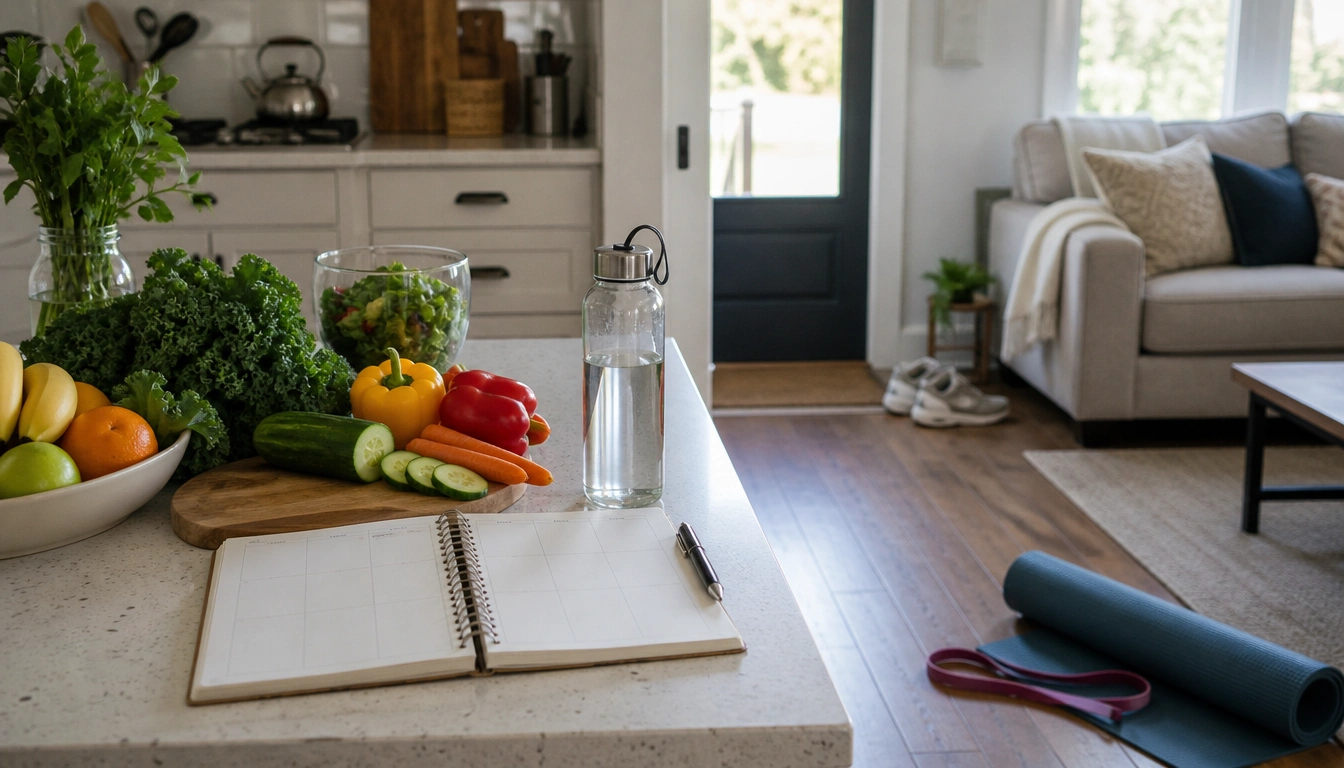
A simple weekly wellness plan starts with three realistic pillars: movement, food, and sleep. Pick one small goal for each, tie it to a cue in your week, and keep the plan flexible enough to survive busy days. For absolute beginners, the best plan is the one you can repeat next week, not the one that looks perfect on paper.
Key Takeaways
- Build your weekly wellness plan around movement, food, and sleep instead of trying to overhaul everything at once.
- Use cues and context, like a lunch break or grocery day, so healthy actions happen automatically more often.
- Small exercise blocks count; beginners can build toward public-health activity goals with 10-minute bouts.
- A basic food plan works better when you choose a few simple dinners, easy produce, and a food-first approach.
- Make the plan friction-light by preparing shoes, clothes, workout space, and groceries ahead of time.
- Review the week without judgment, then adjust the next one so the plan stays realistic.
Start with one small goal for each pillar
A practical weekly wellness plan for beginners works best when it feels like a support system, not a test. Instead of trying to change your exercise, diet, and sleep all at once, choose one realistic goal for each pillar: one movement goal, one food goal, and one sleep goal. That keeps the plan small enough to start and clear enough to repeat.
Think in weekly actions, not in vague intentions. “Move more” is hard to follow. “Walk for 10 minutes after lunch on three days” is easier because it has a time, a place, and a trigger. The same idea works for food and sleep. You might decide to plan three dinners before the week begins, or shut down screens at a set time most nights.
This cue-based approach reflects what behavioral research shows: people follow through more often when an action is linked to a specific context. For beginners, that matters more than motivation. You are not trying to become a different person by Monday; you are building a routine that can survive ordinary life.
Build movement around achievable public-health baselines
Public-health guidance from the CDC and the NHS gives beginners a useful target: adults should aim for at least 150 minutes of moderate-intensity activity each week, or 75 minutes of vigorous activity. If that sounds out of reach, break it into small pieces. Ten-minute blocks still count, and they are often the best way to begin after a long inactive period.
Moderate activity is usually something that raises your breathing and heart rate while still allowing you to talk, such as brisk walking, casual cycling, or dancing. Vigorous activity feels more demanding and may make conversation difficult. Beginners do not need to choose one or the other perfectly; the point is to accumulate movement in a way that fits your week.
A beginner might start with three 10-minute walks, two longer walks, or several short activity breaks spread through the day. This makes the 150-minute guideline feel less like a rigid hurdle and more like a weekly total you can build toward gradually. Some activity is better than none, especially if you are currently doing very little.
Add strength and food planning without making it complicated
Alongside aerobic movement, the CDC recommends muscle-strengthening activity on at least two days per week, targeting major muscle groups such as the legs, hips, back, abdomen, chest, shoulders, and arms. For beginners, that does not require a gym membership or advanced equipment. Simple bodyweight movements, resistance bands, or light weights can be enough to get started safely.
One practical way to organize it is to assign strength work to two predictable days. The exact exercises matter less than consistency. A short routine might include squats to a chair, wall or counter push-ups, a hinge or bridge movement, and a pull or row variation with a band. Keep it brief enough that you are willing to repeat it next week.
Food planning works best at the weekly level too. Rather than counting calories, use a food-first approach: plan a few balanced dinners, buy easy produce, and keep meals simple enough to assemble on tired days. The NHS and public-health frameworks consistently emphasize variety, including fruits and vegetables, whole grains, lean proteins, and healthy fats. Pre-washed greens, frozen vegetables, fruit you can grab quickly, and repeatable dinners can do most of the work.
If you want a low-pressure structure, choose two or three dinners you can rotate through the week. Pair each meal with a protein source, a colorful vegetable, and a satisfying starch or whole grain. That is often more sustainable than trying to make every meal “ideal.”
Reduce friction before the week starts
Most beginner plans fail for boring reasons: the shoes are hard to find, the workout space is cluttered, the groceries are missing, or the evening is too chaotic. A good weekly wellness plan removes as much friction as possible before the week begins.
Set up the environment around the habit you want. If you plan to walk in the morning, place your shoes, socks, and outer layer where you can see them. If you plan to do strength work at home, leave the mat, band, or light weights in one visible spot. If your goal is to eat more produce, buy options that require little prep and keep them where you will notice them first.
This is not about creating a perfect wellness corner. It is about shortening the distance between intention and action. The fewer steps between “I should do this” and “I can start now,” the more likely the habit is to happen on an ordinary Tuesday.
Design a sleep routine that supports the rest of the plan
Sleep is not separate from wellness; it changes how much energy you have for movement and how steady your appetite feels. The grounded guidance here is simple: aim for a consistent sleep window and enough quality rest most nights, with many adults doing well around seven to eight hours. If sleep is scattered, the rest of the week often feels harder.
A beginner-friendly sleep routine does not need to be elaborate. Choose one wind-down cue, one screen boundary, and one bedtime target. Your cue might be brushing your teeth, dimming the lights, making tea, or changing into sleep clothes. Your screen boundary might be putting the phone away before bed. Your bedtime target should be realistic enough that you can keep it on most nights, not only on ideal ones.
The goal is to signal to your body that the pace is changing. A predictable evening routine can make it easier to fall asleep and easier to wake up with enough energy to follow your weekly plan. If late-night scrolling or irregular bedtimes are your main barriers, start there before trying to optimize anything else.
Use a weekly template that can bend with real life
A flexible template is more useful than a strict schedule because real weeks are uneven. Work runs late, family needs change, motivation drops, and energy varies. A good beginner plan accounts for that from the start.
Here is a simple template you can adapt:
- Monday: 10-minute walk after lunch; pick up groceries on the way home.
- Tuesday: Short strength session at home; prepare one simple dinner.
- Wednesday: Rest or gentle movement, such as an easy walk or stretching.
- Thursday: 10- to 20-minute walk or another small movement block.
- Friday: Strength day or an active errand like walking to a store.
- Saturday: Longer movement session if energy allows; refill produce and staples.
- Sunday: Light review, plan meals, and set out what you need for the week.
If your week gets disrupted, keep the framework and shrink the task. A missed 30-minute workout can become a 10-minute walk. A planned dinner can become a simpler version using what you already have. Flexibility is not failure; it is the skill that keeps a plan alive.
This is especially helpful for busy adults, parents, shift workers, and anyone with unpredictable days. The plan should guide you, not punish you. If a low-energy day arrives, do the smallest version of the habit instead of dropping the whole week.
Adjust for age, health conditions, and other safety concerns
Beginners do not all start from the same place. Older adults, pregnant people, and people managing chronic conditions may need a slower pace, lower-impact choices, or medical guidance before increasing intensity. The NHS and CDC both support tailoring activity to the person, not forcing a one-size-fits-all plan.
It is wise to check with a healthcare professional before starting a new routine if you have been sedentary for a long time, or if you have heart, lung, joint, balance, or metabolic concerns such as diabetes. If you are pregnant, recently postpartum, or managing a chronic condition, medical advice can help you decide what kinds of movement are appropriate and how to progress safely.
During exercise, pay attention to the difference between ordinary muscle effort and warning signs. Mild soreness or fatigue can be expected when you are starting out. Sharp pain, chest pain, dizziness, unusual shortness of breath, or joint pain that changes how you move should prompt you to stop and seek advice. Wellness should feel manageable, not like you have to override your body.
Review the week and make one small change
At the end of the week, spend a few minutes looking back without judgment. Ask three questions: What did I actually do? What was easy enough to repeat? What got in the way? This review keeps the plan honest and prevents the all-or-nothing pattern that causes many beginners to quit after a rough week.
Use the answers to make one adjustment for the next week. If you missed long workouts, shorten them. If dinners were hard, simplify the meal plan. If mornings never worked, move activity to lunch or evening. The goal is not to build the perfect plan; it is to make the next version slightly easier to follow.
Over time, those small adjustments add up. A weekly wellness plan becomes useful when it is stable enough to repeat and flexible enough to survive life. That balance is what turns a first attempt into a habit you can actually live with.
Frequently Asked Questions
How much exercise should a beginner aim for in a week?
A common public-health target for adults is 150 minutes of moderate-intensity activity a week, or 75 minutes of vigorous activity. Beginners do not need to start there on day one. If you are new to exercise, begin with smaller bouts and build gradually.
Can I still make progress if I only have 10-minute exercise blocks?
Yes. Small bouts of movement still count and can be spread across the week. Ten-minute walks or short home sessions are a realistic way to begin, especially if you have been inactive. Over time, those blocks can add up to a meaningful weekly total.
What should a beginner include in a basic weekly meal plan?
Keep it simple: a few repeatable dinners, easy produce, and balanced meals built around protein, vegetables, and a satisfying starch or grain. A food-first approach is often easier to sustain than calorie counting, especially when you are just starting out.
How do I make a wellness plan flexible enough for a busy or unpredictable week?
Build in smaller versions of each habit and allow for substitutions. A missed workout can become a short walk, and a planned dinner can become a simpler meal from ingredients you already have. The point is to keep the routine alive, even when the schedule changes.
When should a beginner check with a doctor before starting a new wellness routine?
Check with a healthcare professional if you have been inactive for a long time or if you have heart, lung, joint, balance, pregnancy-related, or metabolic concerns such as diabetes. Medical advice is also important if exercise causes chest pain, dizziness, sharp joint pain, or unusual shortness of breath.
The Bottom Line
A beginner wellness plan works best when it is small, specific, and tied to real weekly cues. Focus on movement, food, and sleep together so the plan supports your energy rather than competing with it.
Start with what you can repeat: short walks, two strength days, a few simple meals, and a consistent bedtime routine. If the week changes, shrink the habit instead of abandoning it.
Review what happened, adjust one thing, and keep going. That is how a plan moves from hopeful idea to something you can actually sustain.
Medical disclaimer
Medical disclaimer: This content is for educational and informational purposes only and is not a substitute for professional medical advice, diagnosis, or treatment. Dietary needs and supplement suitability vary by individual.
Sources
- Centers for Disease Control and Prevention (CDC) — cdc.gov. Accessed November 2026.
- National Health Service (NHS) — www.nhs.uk. Accessed November 2026.
- Centers for Disease Control and Prevention (CDC) — cdc.gov. Accessed November 2026.
- National Health Service (NHS) — oxfordhealth.nhs.uk. Accessed November 2026.
- National Health Service (NHS) — hee.nhs.uk. Accessed November 2026.
