
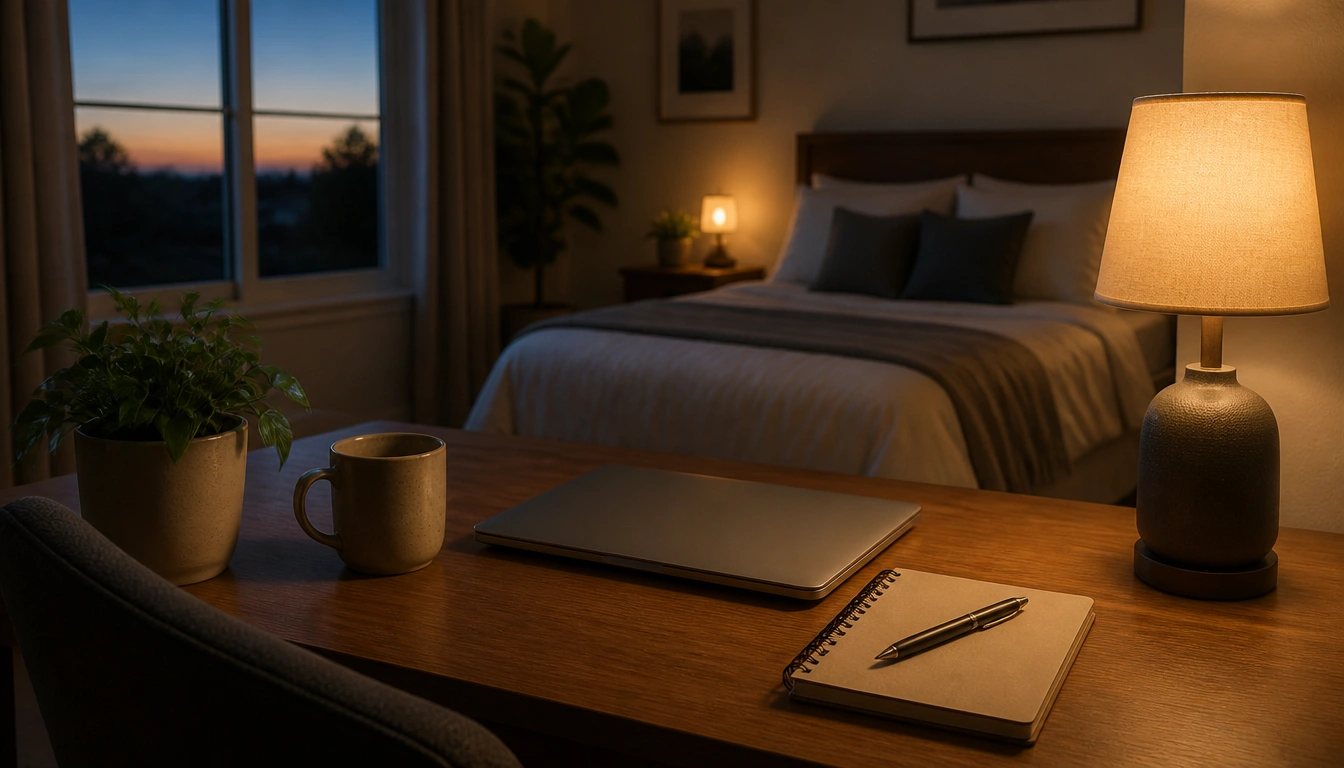
If you work from home, a simple sleep journal should track only a few high-yield details: when you logged off, when you got in bed and woke up, morning light exposure, caffeine and late meals, and anything that blurs the line between work and rest. Used for about two weeks, it can show whether your sleep problems are tied to boundary blur, screen time, schedule drift, or your sleep environment.
Key Takeaways
- Track the workday exit point, not just bedtime. For remote workers, logoff time and a short transition ritual often matter as much as sleep timing.
- Keep the journal small and repeatable. A paper notebook with five fields is usually easier to maintain than a long app-based diary.
- Morning light and a consistent wake time are useful circadian anchors, especially if you rarely leave home before noon.
- If your bedroom is also your office, note what keeps work visually present at night: an open laptop, uncovered desk, notifications, or scattered files.
- Use the journal to test one change at a time, such as a fake commute, earlier caffeine cutoff, or a screen-free wind-down.
- If you have loud snoring, gasping, major daytime sleepiness, or persistent insomnia, tracking should not replace medical evaluation.
Why working from home can disrupt sleep
Working from home can make sleep harder for reasons that are easy to miss while you are living them. Without a commute, a lunch break away from the desk, or a clear end-of-day routine, the brain gets fewer cues that work is over. That boundary blur can leave you mentally “on” late into the evening, which makes it harder to settle down for sleep.
Remote work can also reduce exposure to morning outdoor light, especially if you roll from bed to laptop soon after waking. According to the CDC and sleep health guidance from major health organizations, regular sleep works best when the body gets strong daily time cues and a steady wake time. Those cues help keep the internal clock aligned with the day-night cycle.
There is also a behavioral side. If you answer emails from bed, keep the laptop open in the bedroom, or wind down by scrolling work messages, the bed can start to feel like a place for alertness and problem-solving instead of sleep. Over time, that association can make sleep onset slower and night wakings more frustrating.
What a simple sleep journal should actually track
A useful sleep journal for remote workers is short enough that you will keep using it. You do not need every detail about your day. You need a small set of entries that can show whether sleep problems track with work boundaries, light exposure, stimulation, or environment.
For most people, five daily fields are enough:
- Logoff time: When did you stop work for the day, and did you truly stop or keep checking messages?
- Sleep timing: When did you get into bed, when did you think you fell asleep, and when did you wake up for the day?
- Morning light and wake time: Did you get outside soon after waking, and did your wake time stay fairly consistent?
- Food, caffeine, and movement: Did you have caffeine late in the day, eat a heavy meal close to bed, or have very little movement?
- Evening wind-down and bedroom context: What did you do in the last hour, and was the bedroom also a workspace or a place where work items were visible?
If you want to keep it even simpler, choose the same five fields every day and add a one-line note only when something unusual happened, such as a late meeting, a stressful deadline, a nap, or a room temperature that felt too warm or too cold.
A two-week paper template for remote workers
A paper journal works well because it is easy to keep beside the bed and less tempting to turn into a late-night screen activity. A single page can cover one week, with two weeks giving you enough information to look for repeating patterns without overtracking.
Try this layout:
- Date
- Logoff time
- Morning light before 10 a.m.: yes / no
- Caffeine after early afternoon: yes / no
- Heavy meal within 2–3 hours of bed: yes / no
- Exercise or long walk today: yes / no
- Bedtime
- Wake time
- How I slept: good / okay / poor
- One note: any late work, screen use, bedroom issue, or stressor
The goal is not perfect sleep science. The goal is to create a low-friction record that lets you answer a practical question: what seems to happen on the days when sleep goes badly?
To use it well, fill it in at roughly the same time each day. Many people do best by completing the previous night’s sleep entry in the morning and then adding the workday details at the end of the day before bed. That keeps the journal from becoming another screen-based task at night.
How to spot patterns without overtracking
After about two weeks, look for simple clusters rather than one-off bad nights. A single poor night can happen for many reasons. Repeated patterns are what matter.
Start with the most obvious remote-work variables: logoff time, morning light, and wake time. If late work often follows shorter sleep or more restless nights, that is a strong clue. If sleep improves on days when you get outside early, that points to circadian anchoring. If your wake time drifts late on weekends, that can weaken the rhythm you are trying to set during the week.
Then scan for common triggers that are easy to overlook: afternoon caffeine, large evening meals, a nap that was longer than planned, exercise done very late, or pre-bed screen use that lasted longer than intended. Research and clinical guidance consistently support the value of regular schedules, light exposure, and limiting stimulating devices close to bedtime.
Use the journal to ask narrow questions such as: Do nights improve when I stop caffeine earlier? Do I sleep better when I get outside soon after waking? Do I have more trouble falling asleep on days when I work late in the bedroom? The more specific the question, the more useful the answer.
WFH fixes that pair with journaling
Once your journal points to a likely pattern, match it with a small behavior change rather than a full lifestyle overhaul. For remote workers, one of the most effective changes is a “fake commute”: a brief walk, stretch break, or other transition ritual after logoff. The point is to mark the shift from work mode to home mode.
Workspace boundaries matter too. If your desk is in the bedroom, close the laptop, shut down work notifications, and cover the desk or move work tools out of sight at the end of the day. That simple visual change can reduce the mental pull of unfinished work. If you can, keep the bed for sleep rather than email, meetings, or late-night planning.
Morning light is another practical anchor. Get outside soon after waking when possible, even for a short walk or coffee on the porch. A consistent wake time helps reinforce that cue. Together, light and timing can make it easier for your body clock to stay aligned, especially if your days are otherwise spent indoors.
For the evening, aim for a calmer final 30 to 60 minutes. That does not have to mean a perfect routine. It can mean dimmer lights, a paper book, light stretching, or preparing for tomorrow so you do not keep mentally rehearsing the workday. Major sleep guidance also supports reducing electronics before bed, since screens can keep you alert and draw work back into view.
How to adapt the journal for a bedroom office or small space
If the bedroom is also your office, your journal should record the extra friction points that come with limited space. Note whether the desk stayed visible, whether your work chair or laptop remained in the room, and whether you were able to create even a small “off-duty” shift at night. That matters because room layout can keep work thoughts active long after logging off.
In a studio apartment or shared space, the goal is not to create a perfect separation that is impossible to maintain. It is to reduce cues that keep the brain in work mode. Closing the laptop, covering the monitor, placing files in a box, or putting the charger out of sight can all help. If you share the room with someone else, note whether noise, light, or different schedules are part of the sleep problem.
This is also where environment details matter. Record if the room feels too warm, too cool, or disrupted by a partner, child, or roommate. Clinical sleep advice commonly emphasizes a quiet, dark, comfortably cool bedroom. For some people, especially during perimenopause or menopause, night sweats or temperature swings can make awakenings more frequent. If that seems relevant, write it down rather than assuming it is “just stress.”
When simple tracking is not enough
A sleep journal is useful for lifestyle patterns, but it should not be the only step if the problem is persistent or severe. If sleep difficulties happen three or more nights per week for more than a month and affect daytime function, it is reasonable to speak with a clinician. That is especially true if you feel unsafe driving, struggle to stay awake during the day, or notice your mood and anxiety worsening.
Get checked sooner if you snore loudly, gasp, choke, or have witnessed pauses in breathing during sleep. Those symptoms can point to sleep apnea, which a journal alone cannot diagnose. A clinician can also help if insomnia is tied to depression, significant anxiety, hot flashes, pain, restless legs symptoms, or medication side effects.
If you lie awake in bed for roughly 15 minutes and feel increasingly alert, clinical behavioral guidance suggests getting out of bed and doing something quiet and low-stimulation in dim light until sleepiness returns. The journal can help you notice how often this happens, but it should not turn into a place to monitor every minute of the night.
A fill-in-the-blank entry you can start tonight
If getting started feels awkward, use a short template and keep it on one page:
Date: ______________
Logged off work at: ______________
Got morning light: yes / no
Caffeine after early afternoon: yes / no
Heavy meal near bedtime: yes / no
Exercise or walk: yes / no
In bed at: ______________
Woke at: ______________
Sleep quality: good / okay / poor
One note: ______________
That is enough to begin. You can always add more later, but starting small makes the habit more likely to stick. For remote workers, the biggest gains usually come from noticing the same few cues again and again: when work truly ends, when light begins, and what happens between the last email and the first hour of sleep.
Frequently Asked Questions
What are the most important sleep diary entries for remote workers?
The most useful entries are logoff time, bedtime and wake time, morning light exposure, caffeine or heavy meals late in the day, and any work-related activity in the bedroom. Those details are often enough to show whether boundary blur, schedule drift, or stimulation is affecting sleep.
How long should I keep a sleep journal before looking for patterns?
Two weeks is a practical starting point for many adults. That is usually long enough to spot repeat patterns without making tracking feel like a chore. If your schedule changes a lot, you may need a longer stretch, but keep the format simple.
What should I do if my bedroom is also my home office?
Track the overlap directly. Note whether your laptop, paperwork, or notifications stay visible at night. At the end of the workday, close the laptop, shut down alerts, and put work items out of sight if you can. Even a small visual reset can help separate work from sleep.
How can I use a sleep journal to find caffeine, meal, or screen-time triggers?
Compare nights with your usual habits against nights that feel worse. Look for repeat links between later caffeine, heavier evening meals, longer screen use, and trouble falling asleep or staying asleep. Try changing one variable at a time so you can tell what actually helped.
When should sleep problems be evaluated by a clinician instead of managed with self-tracking?
Seek medical evaluation if sleep problems happen three or more nights a week for over a month and affect daytime life, or sooner if you snore loudly, gasp at night, feel dangerously sleepy, or notice mood changes, anxiety, or low mood getting worse.
The Bottom Line
A simple sleep journal for remote workers should stay small enough to use every day. Focus on the cues that most often get blurred by working from home: when work ends, when light begins, and what keeps the bedroom feeling like an office.
Use the journal for two weeks, then look for repeated patterns rather than isolated bad nights. If the entries point to late caffeine, weak morning light, screen use in bed, or an unclear work-to-rest transition, test one change at a time and keep what helps.
If sleep problems are frequent, severe, or paired with snoring, gasping, daytime sleepiness, or worsening mental health, self-tracking is not enough on its own. That is the point to involve a healthcare professional.
Medical disclaimer
Medical disclaimer: This content is for educational and informational purposes only and is not a substitute for professional medical advice, diagnosis, or treatment. Dietary needs and supplement suitability vary by individual.
Sources
- Centers for Disease Control and Prevention (CDC) — cdc.gov. Accessed October 2026.
- National Health Service (NHS) — www.nhs.uk. Accessed October 2026.
- National Health Service (NHS) — uhs.nhs.uk. Accessed October 2026.
- Academic Research Institution — usc.edu. Accessed October 2026.
