
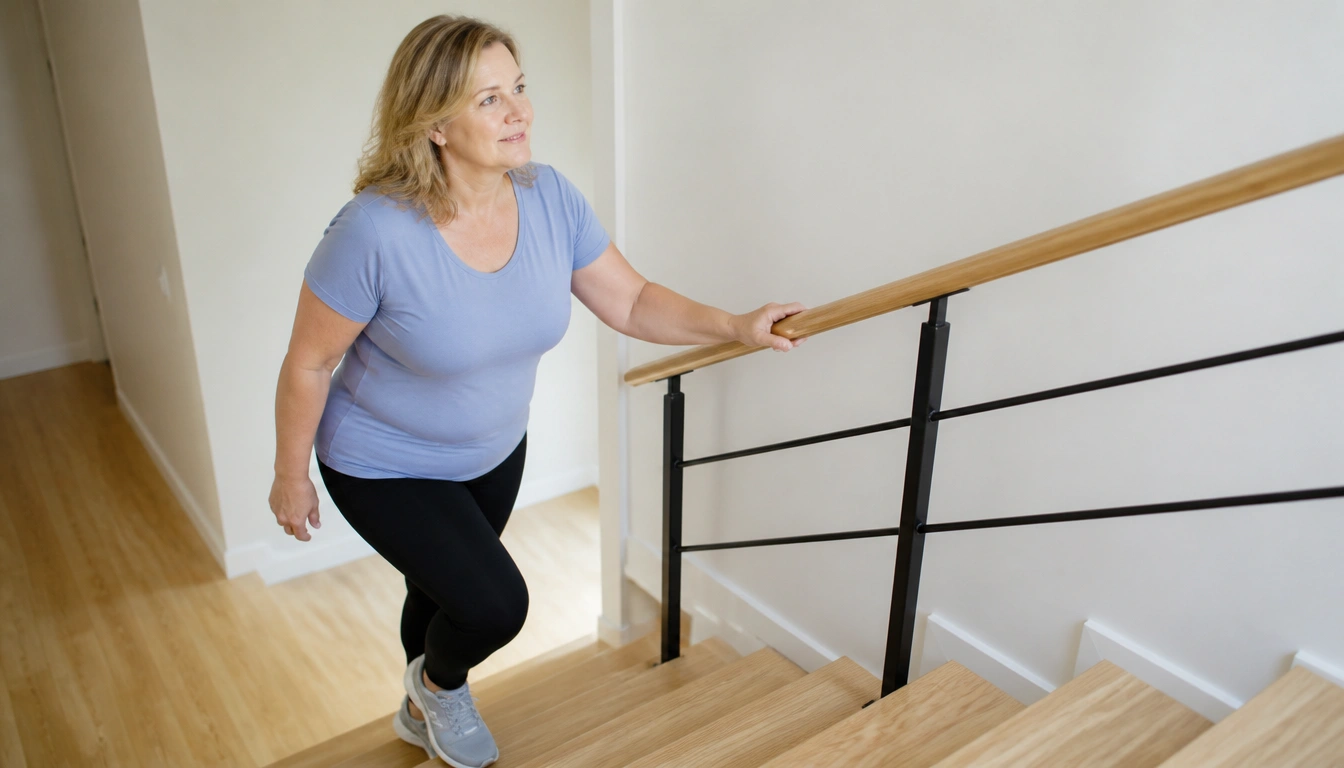
Start with a very small stair walking routine: 1 flight, 2 to 3 times per session, 2 to 3 sessions per week, with rest days between workouts. Go at a conversational pace, use the handrail, and stop if you feel chest pain, dizziness, sharp joint pain, or unusual shortness of breath. For many beginners, walking up and taking the elevator down is a safer first step than doing full up-and-down laps.
Key Takeaways
- Stair walking is efficient because it raises heart rate quickly and uses the large muscles of the legs and hips.
- For complete beginners, going up is the main training stimulus; coming down adds control and balance demands, but can bother sensitive knees.
- Use the FITT principle: start with short sessions, low frequency, and gradual progression instead of trying to do stairs daily.
- Supportive shoes, a clear staircase, and a steady handrail matter more for safety than speed or intensity.
- If stairs trigger knee pain, dizziness, chest discomfort, or strong breathlessness, stop and get medical advice before continuing.
Why stair walking is useful for beginners
Stair walking is one of the most time-efficient ways to raise your heart rate without equipment. Because you are lifting your body upward against gravity, the effort is higher than walking on flat ground. That makes it a useful starter cardio option for sedentary adults who want something simple, inexpensive, and practical at home or work.
It also recruits the muscles that matter for daily life: quadriceps, glutes, hamstrings, and calves. According to the Centers for Disease Control and Prevention, adults need regular aerobic activity and muscle-strengthening work each week; stair walking can contribute to both, especially when you begin with short, manageable bouts. Research and exercise guidance from the American College of Sports Medicine support gradual progression rather than jumping straight into long, hard sessions.
What it is not: a test you need to pass in one go. For a beginner, the goal is to build tolerance and consistency, not to finish a long staircase as fast as possible.
Who should start now, and who should get clearance first
This routine is a good fit for adults who want a low-cost way to start moving, especially if they have access to a safe staircase and can walk on flat ground without major problems. It can also work well for people who want short activity breaks during the day rather than a formal workout.
Some people should pause and get medical clearance before starting. That includes anyone with known heart disease, uncontrolled high blood pressure, frequent dizziness, recent falls, significant balance problems, or joint pain that makes stairs feel unstable. If you have a respiratory condition that makes exertion hard to judge, or if a clinician has told you to limit vigorous activity, ask for individualized guidance first.
Older adults can do stair work too, but they may need a slower start, a handrail on both sides if available, and a shorter first dose. If you are not sure whether stairs are appropriate for you, a physical therapist or clinician can help tailor the routine.
How to start safely on the staircase
Good form is simple: stand tall, look ahead, and take controlled steps. Avoid leaning heavily on the handrail, but do use it for balance. Keep your whole foot on each step when possible, and move at a pace that feels steady rather than rushed.
Choose a staircase that is clean, dry, well lit, and free of clutter. If the steps are steep, narrow, slippery, or poorly maintained, choose another staircase or skip the routine until you have a safer option. Supportive athletic shoes with a grippy sole are a better choice than socks, sandals, heels, or smooth street shoes.
If you are worried about balance, start with a few step-ups on a low, stable step before using a full staircase. The movement pattern is similar, but the environment is easier to control.
A beginner dose and a simple 2-week progression
The FITT principle helps keep stair walking beginner-friendly. For frequency, begin with 2 to 3 sessions per week, not every day, so your legs and joints have time to recover. For time, start with just 1 flight or a very short stair segment. For intensity, use a slow-to-moderate pace that lets you stay in control. For type, keep the movement basic: walk up, pause, and repeat if you feel okay.
A practical starter session can look like this: walk up one flight, rest briefly at the top or bottom, then repeat 2 to 3 times total. If that feels easy, stay with that amount for several sessions before adding more. Consistency matters more than doing a bigger workout on day one.
Week 1: Do 2 sessions. Use one flight, 2 to 3 repetitions, and take the elevator down if your knees feel sensitive. Week 2: If Week 1 felt manageable and soreness was mild, move to 3 to 4 repetitions or add a second flight on one of the sessions. Keep a rest day between workouts. That is usually enough to move from zero activity to a routine you can actually sustain.
Upstairs-only vs. up-and-down routines
For most beginners, going up provides the main conditioning stimulus. It raises the heart rate and challenges the large leg muscles without adding the same amount of knee stress that some people feel on the way down. If your goal is to start gently, an upstairs-only routine is a perfectly valid option.
Walking down adds eccentric loading, which means your muscles lengthen while they control your body weight. That improves control and balance, but it can also be the part that irritates the knees most. If descents bother you, limit how often you do them, use the handrail, slow the pace, or take the elevator down.
A useful middle ground is to walk up one flight, pause, and descend only if it feels comfortable. If not, skip the descent and repeat the climb later. You are still getting value from the session.
How to judge effort without overdoing it
For absolute beginners, stair walking should feel challenging but controllable. A good test is the conversation check: you should be able to speak in short sentences while climbing. If you are gasping, pushing through severe fatigue, or losing form, the pace is too hard.
Watch for fatigue cues such as heavy legs, stumbling, needing to grab the rail more than usual, or feeling shaky when you finish. Mild breathlessness and leg effort are expected. Sharp pain, chest pressure, faintness, or a sudden change in how you feel are not. Stop immediately if those happen.
Because stair walking can become vigorous quickly, it is easy to do too much in the first week. The safest approach is to finish a session feeling like you could have done a little more. That leaves room for progress later.
Practical troubleshooting for common beginner problems
Knee discomfort on descents: shorten the descent, take the elevator down, or do only the upward portion. If the discomfort is sharp, persistent, or worsening, stop and get assessed. Descending is optional in the beginning.
Breathlessness: slow down, cut the repetitions, or use one flight instead of multiple. If you cannot recover within a short rest, the session was probably too hard for your current fitness level.
Balance concerns: keep one hand lightly on the rail, avoid carrying bags, and use a staircase with good lighting. If balance feels unreliable, try a stable step-up exercise before returning to stairs.
No stairs at home: use stairs at work, in a public building, or in an apartment common area if allowed. If stairs are not available, a step-up onto a sturdy platform is a workable substitute until you find a safe staircase.
Footwear or surface problems: do not force it. Slippery floors, loose rugs, or worn shoes raise the fall risk more than they help fitness.
How to make stair walking part of real life
The easiest way to keep a routine going is to attach it to something you already do. This is habit-stacking: after your morning coffee, after lunch, when you get home from work, or before your shower, do a short stair session. The routine becomes less of a decision and more of a cue.
You can also build a weekly pattern that fits real life. For example, do stair walking on Monday, Wednesday, and Friday, or choose two days if recovery feels slow. If your schedule is unpredictable, make the goal “two short sessions this week” rather than “exercise every day.” That keeps the plan realistic.
Some people do best with a micro-habit: one flight up every time they pass the stairs, as long as the staircase is safe and the pace stays easy. Others prefer a dedicated 5-minute session. Both can work if they are repeatable.
The point is to create a routine you can keep doing after the initial motivation fades. A modest plan you repeat for months is far more useful than a hard plan you abandon after a week.
Frequently Asked Questions
How many stairs or flights should a beginner do at first?
Start small: one flight or a short stair segment, then repeat it 2 to 3 times if you feel okay. The right amount is the dose you can recover from and repeat later, not the biggest amount you can tolerate once.
Should I walk both up and down the stairs as a beginner?
Not necessarily. Walking up is the main conditioning part of the workout. Going down adds control and balance work, but it also may bother the knees. If descents feel uncomfortable, take the elevator down or skip them for now.
How often should I do stair workouts each week?
A good beginner target is 2 to 3 sessions per week with rest days between sessions. That gives your legs time to recover and lowers the chance that you overdo it early on.
What should I do if my knees hurt when going downstairs?
Shorten or skip the descent, use the handrail, slow down, or take the elevator down. If the pain is sharp, persistent, or worsening, stop the routine and ask a healthcare professional for advice.
Who should avoid stair walking or get medical clearance first?
Anyone with heart disease, uncontrolled blood pressure, frequent dizziness, recent falls, major balance issues, or painful joint problems should check with a clinician first. If you are unsure, individualized medical advice is the safest next step.
The Bottom Line
A stair walking routine can be a smart entry point for complete beginners because it is efficient, low-cost, and easy to scale. The safest start is short sessions, a slow-to-moderate pace, supportive shoes, and rest days between workouts.
For most beginners, walking up is the main work and walking down is optional. If your knees do not like descents, use the handrail, limit them, or take the elevator down. Progress by adding a little more only after the current dose feels manageable.
The best routine is the one you can repeat safely. Start small, attach it to a daily habit, and build gradually over two weeks instead of trying to force a big workout right away.
Medical disclaimer
Medical disclaimer: This content is for educational and informational purposes only and is not a substitute for professional medical advice, diagnosis, or treatment. Dietary needs and supplement suitability vary by individual.
Sources
- National Institutes of Health (NIH) — nih.gov. Accessed October 2026.
- Centers for Disease Control and Prevention (CDC) — cdc.gov. Accessed October 2026.
- American College of Sports Medicine (ACSM) — acsm.org. Accessed October 2026.
- Academic Research Institution — harvard.edu. Accessed October 2026.
