
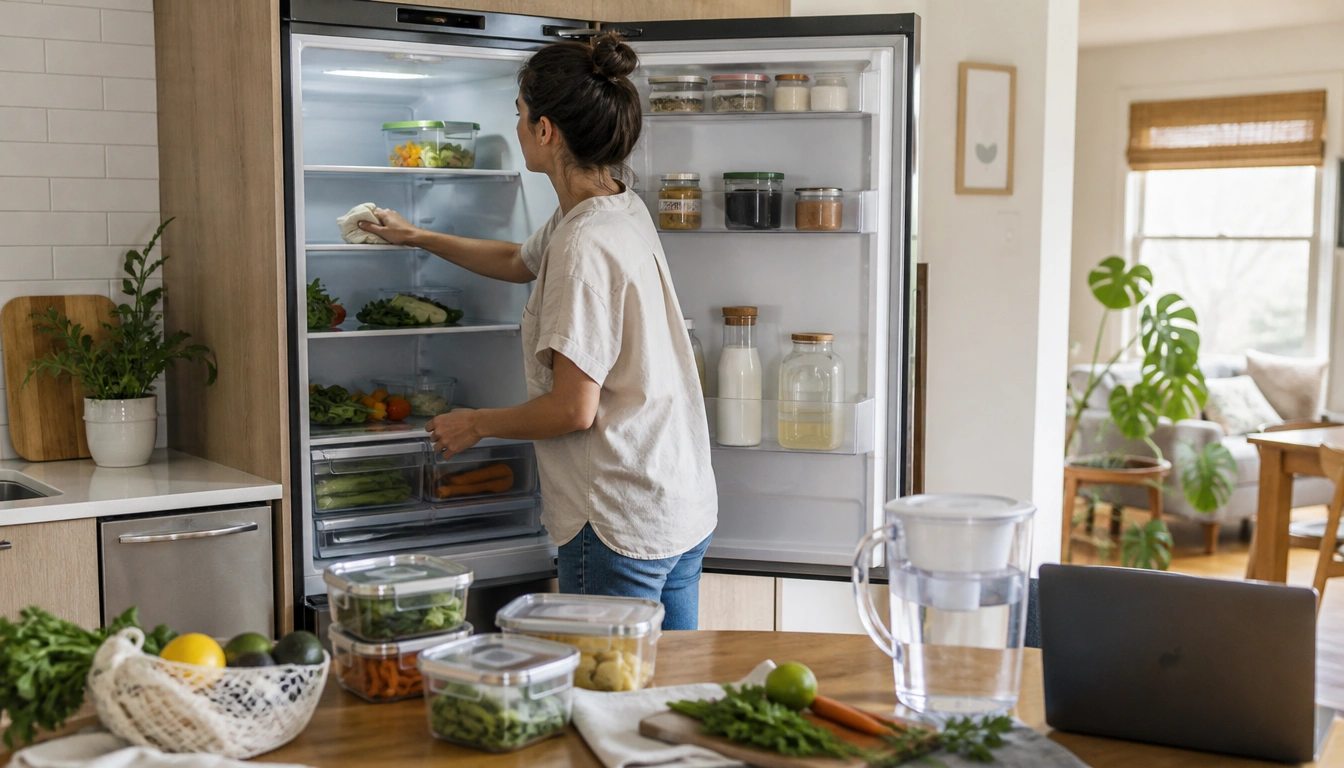
Set aside 20–30 minutes once a week to toss expired food, move older items forward, check your fridge is at 40°F or below, wipe high-touch surfaces, and restock the kitchen so ready-to-eat foods and water are easy to see. For remote workers, that reset matters because the kitchen doubles as a breakroom, lunch spot, and work zone, so clutter and food cues can quickly affect snacking, focus, and food safety.
Key Takeaways
- A weekly kitchen reset keeps leftovers, lunch ingredients, and workday snacks visible, organized, and safer to use.
- Use the 2-hour rule and the 3-to-4-day refrigerator window to decide what to toss, freeze, or move to the front.
- Clean routine messes with hot, soapy water; sanitize only when raw meat spills or recalled items call for it.
- Keep dairy, eggs, and ready-to-eat foods in the main fridge compartment, raw meat on the bottom shelf, and condiments in the door.
- Pre-washed produce and a simple hydration station reduce mid-day searching and make healthier choices easier.
- Single-person households often need to freeze portions on Day 1 so leftovers do not age out before the next reset.
Why remote workers benefit from a weekly kitchen reset
For remote workers, the kitchen is rarely just a kitchen. It becomes a breakroom between meetings, a quick-service lunch station, and often the most visited part of the house during the workday. That makes clutter more than a visual annoyance. It can add cognitive noise, make healthy choices feel harder, and encourage random snacking because food is in sight and in reach.
A weekly kitchen reset gives the space a clean start before the next workweek. The practical gains are straightforward: safer food storage, less wasted food, fewer mystery containers, and less time spent hunting for lunch ingredients or a clean glass. It also reduces decision fatigue. When the items you actually use are easy to find, you spend less mental energy on avoidable choices and more on work.
The easiest version is not a deep clean. Think of it as a 20–30 minute reset with a clear sequence: purge what should be discarded, check the refrigerator temperature, wipe the surfaces you touch most, and restock so the best options are the easiest to grab. If you work from home most days, a small weekly habit can prevent a steady drift toward clutter and food waste.
Clear out expired food, leftovers, and mystery containers
Start with the obvious losses. Open the refrigerator and remove anything that is expired, moldy, leaking, or unidentified. Mystery containers are a common remote-work problem because leftovers get tucked behind drinks or meal-prep boxes and forgotten until the next weekend. If you do not know what it is or when it was cooked, it is usually not worth keeping.
Focus especially on leftovers and takeout components. Public health guidance from the USDA and CDC uses a 2-hour room-temperature rule: perishable food left out for more than 2 hours should be discarded, and the window is even shorter in hot conditions. In the fridge, cooked leftovers are generally best used within 3 to 4 days. If they are still safe but you will not eat them in time, freeze them during the reset instead of letting them drift past the limit.
Single-person households often need a more aggressive approach. If you live alone and know you are not likely to finish a batch meal by midweek, portion it and freeze part of it on Day 1. That is usually better than waiting until Friday and realizing the food has already aged out.
Check the fridge temperature and wipe the work surfaces
Before reorganizing, confirm that the refrigerator is cold enough. USDA and CDC guidance places safe refrigeration at 40°F (4°C) or below. A fridge that runs too warm can turn a normal storage problem into a food safety problem, especially if leftovers, dairy, or cut produce sit there for several days.
Next, check the storage zones. The main compartment is the most stable area and is best for dairy, eggs, and ready-to-eat foods. The door is the warmest, most fluctuating area, so it is better for condiments and other more stable items. Raw meat belongs on the bottom shelf in a sealed container so juices cannot drip onto produce or foods that will not be cooked again. That simple layout lowers cross-contamination risk without requiring a complicated system.
Then wipe the spots that work hardest during the week: counters, handles, fridge shelves, drawer fronts, and the landing zone where lunch is assembled. Routine wiping should use hot, soapy water. That removes visible dirt and food residue and is the right weekly maintenance step for most household messes. Save sanitizing for situations that call for it, such as raw-meat spills or recalled items.
Restock for the week with foods you can see and use
Once the old items are cleared out, put the useful food back in a way that helps future you. Use first in, first out, or FIFO: older items go to the front, newer items go behind them. This is one of the simplest ways to reduce food waste because the food most likely to spoil is also the food you see first.
Make ready-to-eat foods visible. Pre-wash sturdy produce such as grapes, carrots, or celery, dry it well, and store it in a clear container at eye level. That small step matters during a workday because it lowers the friction between hunger and a good choice. If healthy snacks are buried behind ingredients or lunch leftovers, they are much less likely to get eaten.
The same idea helps with drinks. Set up a hydration station near your desk or in a consistent kitchen spot so you are not opening cabinets, searching for cups, or defaulting to caffeine because water feels inconvenient. A visible water pitcher, bottle, or glass can remove one more small decision from the day.
Food-safety rules that matter most in a remote-work kitchen
Not every kitchen reset needs a long list of rules, but a few are worth remembering because they prevent the biggest mistakes. The first is temperature. Keep the refrigerator at or below 40°F, and do not assume food is safe just because the kitchen feels cool. Food safety depends on time and temperature, not on whether the room looks tidy.
The second is the danger zone. The USDA and CDC describe the range between 40°F and 140°F as the zone where bacteria can grow quickly. That is why leftovers should not sit out while you finish a meeting or wait for the next break. If food has been in that range too long, it should be discarded rather than “rescued” by smell or appearance.
The third is separation. Store raw meat away from produce and ready-to-eat foods, and keep containers closed. This matters in a home office kitchen because people often prep a lunch quickly between calls and may not notice small spills or drips. A tidy fridge layout is not only about convenience; it is part of food safety.
Leftovers, cleaning, and sanitizing without confusion
Leftovers are where many weekly resets get stuck, so it helps to use a clear decision pattern. If the food has been out of refrigeration for more than 2 hours, discard it. If it has been refrigerated for 3 to 4 days and you will not eat it soon, freeze it if it is still appropriate to keep. If it is older than that or you cannot confirm how it was handled, throw it away. A neat container is not proof of safety.
Do not rely on smell or appearance alone. Many harmful bacteria do not make food smell bad or look obviously spoiled. That is why the age of the food and how it was stored matter more than whether it seems “fine.” This is especially relevant when you are busy and tempted to keep a container because it still looks usable.
Cleaning and sanitizing are not the same task. Cleaning removes dirt, grease, and food residue with soap and water. Sanitizing adds a stronger step that lowers germs further and is appropriate after raw meat spills or when a recalled item has contacted a surface. Routine weekly shelf wiping does not usually require sanitizing, but a spill from raw chicken juices does. If someone in the household gets symptoms of foodborne illness after eating questionable food, seek medical advice promptly.
Common mistakes and a reset routine that fits your household
One common mistake is trying to reset the whole kitchen at once and getting interrupted. Remote workers often have meetings stacked close together, so the best routine is the one that can survive a pause. Break the reset into short passes: toss, check, wipe, then restock. If you stop after the purge, you still made progress and can finish the next step later.
Another mistake is treating every household the same. In shared homes, the reset should include a quick check of shared shelves, labeled leftovers, and any foods that need to stay separate for allergies or dietary needs. In solo households, the challenge is usually volume rather than coordination. That means using smaller containers, freezing extra portions sooner, and keeping the fridge less crowded so items do not disappear into the back.
For a simple weekly pattern, choose one repeatable day, often Friday afternoon or Sunday evening. Purge first, then verify the fridge is cold enough, wipe the work surfaces, and move the most useful foods to the front. If you keep the same order every week, the reset becomes less of a project and more of a maintenance habit.
How to make the reset stick during a busy workweek
Habit cues matter more than motivation. Link the reset to something already on your calendar, such as the end of the workweek, a grocery delivery, or meal prep. Put a reminder on your phone or calendar so the task does not depend on memory alone. The goal is not perfection; it is making the next reset easy to start.
Low-friction setup helps too. Keep cleaning supplies where they are easy to reach, use clear containers when possible, and assign a spot for leftovers, produce, and drinks. If you have to search for paper towels, rewash containers, or move three things to clean one shelf, the task will feel heavier than it is.
The best version of a weekly kitchen reset is the one that supports your workday with the least resistance. If the kitchen is cleaner, the fridge is organized, and the best food is visible, you are less likely to snack on autopilot or waste time looking for what you need.
| Kitchen zone | Best use | Why it helps |
|---|---|---|
| Main compartment | Dairy, eggs, ready-to-eat foods | Most stable temperature for foods that need consistent cold storage |
| Door | Condiments and more stable items | Handles temperature swings better than more perishable foods |
| Bottom shelf | Raw meat in sealed containers | Reduces the chance of drips contaminating other foods |
| Eye level | Pre-washed produce and lunch items | Makes healthy options easier to notice and use quickly |
Frequently Asked Questions
How long should leftovers stay in the fridge before they need to be tossed or frozen?
Use the 3-to-4-day refrigerator window for cooked leftovers, assuming the fridge stays at 40°F or below. If you will not eat them in time, freeze them earlier rather than waiting until they are borderline. If leftovers sat out for more than 2 hours, discard them.
What parts of the fridge are safest for different foods, like dairy, produce, and raw meat?
Use the main compartment for dairy, eggs, and ready-to-eat foods, the door for condiments and other stable items, and the bottom shelf for raw meat in a sealed container. That layout helps reduce temperature swings and cross-contamination.
How do I tell whether food is unsafe if it still looks and smells okay?
You usually cannot tell by smell or appearance alone. Harmful bacteria may be present without obvious spoilage signs. Food age, storage time, and temperature are more reliable. If you cannot verify safety, or the food has been held too long, toss it.
What is the difference between cleaning and sanitizing a kitchen after raw meat spills?
Cleaning uses soap and water to remove residue and dirt. Sanitizing is an extra step that lowers germs further and is appropriate after raw meat spills or recalled items. For routine weekly wiping, cleaning is usually enough; for raw-meat contamination, sanitize the area after cleaning.
How can a weekly kitchen reset help reduce mindless snacking and decision fatigue while working from home?
When visible clutter and random food cues are reduced, you spend less mental energy deciding what to eat and less time wandering the kitchen. Pre-washed produce, clear containers, and a hydration station make better choices easier to see and grab during the workday.
The Bottom Line
A weekly kitchen reset is a small habit with outsized payoff for remote workers. It helps you protect leftovers, keep the fridge organized, and make the kitchen feel like a useful part of the workday rather than a source of distraction.
Keep the routine simple: purge what is no longer safe, check temperature, clean the surfaces you touch most, and restock so healthy, ready-to-eat foods are visible. Over time, that structure can reduce waste, lower decision fatigue, and make work-from-home meals easier to manage.
Medical disclaimer
Medical disclaimer: This content is for educational and informational purposes only and is not a substitute for professional medical advice, diagnosis, or treatment. Dietary needs and supplement suitability vary by individual.
Sources
- U.S. Government / Health Authority — usda.gov. Accessed October 2026.
- U.S. Government / Health Authority — usda.gov. Accessed October 2026.
- Centers for Disease Control and Prevention (CDC) — cdc.gov. Accessed October 2026.
- Centers for Disease Control and Prevention (CDC) — cdc.gov. Accessed October 2026.
- U.S. Government / Health Authority — foodsafety.gov. Accessed October 2026.
