
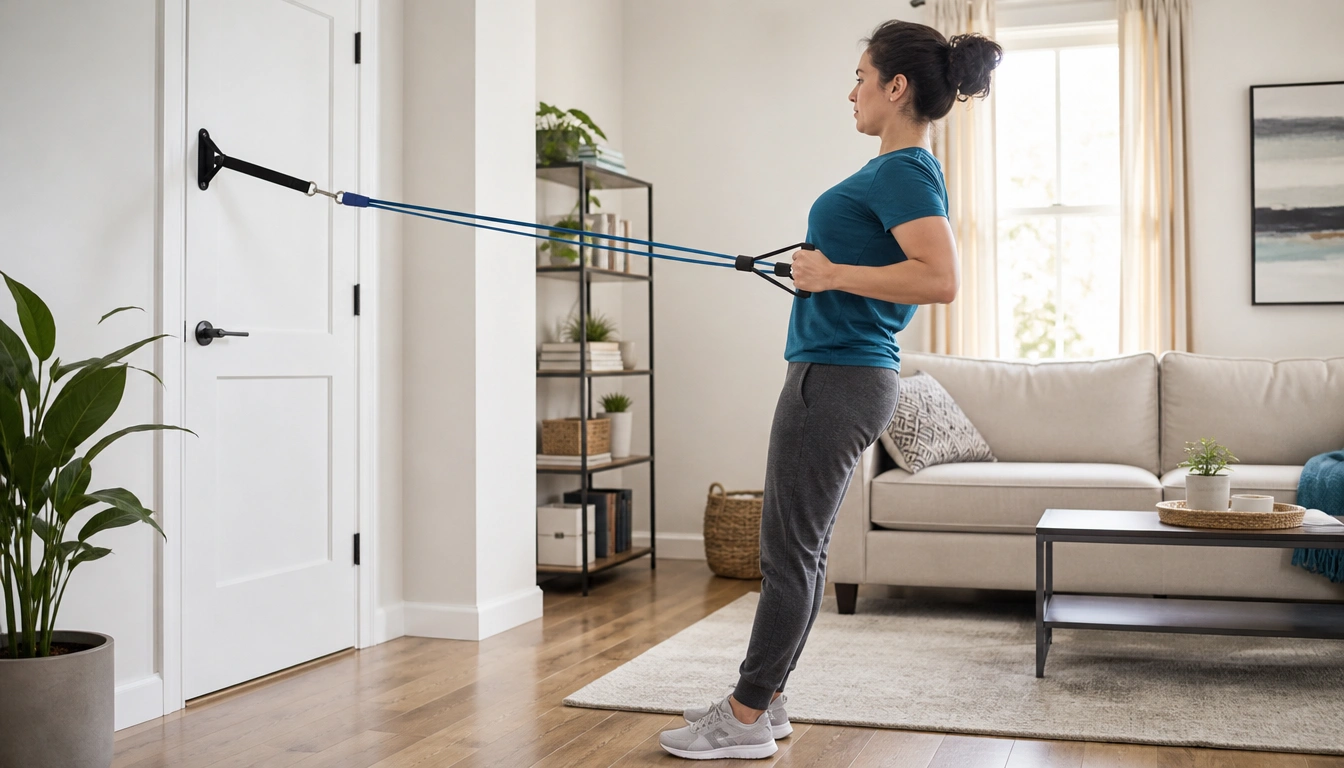
The simplest safe resistance band routine for a beginner at home is a short full-body workout done about twice a week, with at least 48 hours between sessions for the same muscle groups. Start with 1 to 3 sets of 8 to 15 reps for basic moves like rows, squats, chest presses, and pull-aparts. Choose the band that lets you finish the reps with strict form, not the one with the lightest or darkest color name.
Key Takeaways
- Band colors are not standardized across brands, so pick resistance based on whether you can complete the target reps with clean form.
- A beginner routine should train the whole body, not just arms: include a pull, a squat, a press, and an upper-back move.
- Most beginners can start with 1 to 3 sets of 8 to 15 reps, about 2 sessions per week, with at least 48 hours between sessions for the same muscles.
- Inspect bands and anchors before every workout. Replace anything with nicks, dry rot, worn attachment points, or other damage.
- Progress without buying new equipment by increasing reps first, then stepping farther onto the band or slowing the lowering phase.
- Mild muscle fatigue is normal, but sharp, shooting, or persistent joint pain is a stop signal and should not be pushed through.
Why resistance bands work for home strength training
Resistance band starter routine for home fitness works well because bands provide variable resistance: the movement gets harder as the band stretches. That means you can train the muscles through a full range of motion without needing much space, a bench, or a full rack of weights. For many people, that makes bands one of the easiest ways to start strength training at home.
Elastic resistance is also joint-friendly. The load is usually lower at the beginning of a movement and higher near the end, which can feel smoother than a sudden heavy load. Bands also ask your body to stabilize the movement continuously, which is useful for balance, posture, and coordination. Research and professional guidance support bands as a practical way to improve strength and function when they are used progressively and with good technique, including for adults who want low-impact exercise options.
A beginner routine should cover the main movement patterns, not just isolated arm work. The goal is to train the body in a balanced way with one exercise that pulls, one that pushes, one that works the legs, and one that supports the upper back and shoulder posture. That fuller approach matters more than doing a long list of small exercises with light tension.
How to choose the right band
Band color is helpful for organizing a set, but it is not a universal measure of resistance. One brand’s light band may feel similar to another brand’s medium band. Because color labels vary, choose the band that lets you finish the target rep range with controlled form instead of trusting the color name alone.
A good beginner choice is usually a lighter band that feels manageable for technique practice. If you cannot complete the movement without shrugging, twisting, losing balance, or jerking the band, it is too heavy for that exercise. If you can breeze through the top of the rep range without any effort, the band may be too light for now.
It helps to test a band with one exercise at a time. The right resistance for a squat may not be the right resistance for a chest press or pull-apart. If your set ends because the band is forcing sloppy mechanics, step down. If the set ends because the work feels present but still controlled, you are probably close to the right choice.
If you own more than one band, use the lightest one that still challenges you in the target rep range. That gives you room to learn form before you need more tension.
Home setup and safety checklist
Before every session, inspect the band closely. Look for micro-tears, nicks, dry or cracked rubber, stretched-out spots, or worn attachment points. If the band looks compromised, do not use it. A small flaw can turn into a snap under tension.
Anchor choice matters just as much as band choice. Avoid unstable furniture, sharp edges, or anything that can tip, slide, or cut the band. If you use a door anchor, use a proper one made for exercise and make sure the door is latched or locked shut away from the direction of pull. A door that swings open can release the band suddenly.
Grip safety matters too. Keep your hands secure on the handles or ends of the band and avoid wrapping a flat band loosely around the hands or feet in a way that could trap circulation or let it recoil unexpectedly. Keep your face out of the direct line of tension so a slip is less likely to hit you.
Stop the session if you feel sharp pain, shooting pain, or persistent joint pain. Muscular effort, fatigue, and a burn in the working muscle can be normal. Pain that feels sharp, unstable, or like it is in the joint rather than the muscle is a warning sign, not a training cue.
A simple beginner full-body routine
A practical first routine can be built around four exercises: a row, a squat, a chest press, and a pull-apart. Together, they cover the major muscle groups without making the workout complicated.
Band row: Sit tall or stand with the band secured around your feet or anchored in front of you. Pull your elbows back and squeeze your shoulder blades gently together. Keep your chest open and avoid leaning backward. Use 1 to 3 sets of 8 to 15 reps.
Band squat: Stand on the band with feet about shoulder-width apart. Hold the ends at shoulder height or by your sides, then sit back and down as if reaching for a chair. Keep your chest up and knees tracking in line with your toes. Use 1 to 3 sets of 8 to 15 reps.
Band chest press: Anchor the band behind you at chest height or loop it around your upper back if that is safer. Press forward until the arms are straight but not locked. Move slowly back to the start. Use 1 to 3 sets of 8 to 15 reps.
Band pull-apart: Hold the band in front of your chest with straight arms, then pull the hands apart by using the upper back. Keep the shoulders down, not shrugged. Use 1 to 3 sets of 8 to 15 reps.
If you are new to exercise, start with one set of each move and add a second or third set only when the first set feels stable and repeatable. You do not need to exhaust yourself to get value from the session. Clean reps matter more than forcing extra effort.
How often to do it
For a beginner, two sessions per week is a practical starting point and fits public health guidance for muscle-strengthening activity at least two days per week. Leave at least 48 hours between sessions that work the same major muscle groups so your body has time to recover and adapt.
You can place the sessions on nonconsecutive days, such as Monday and Thursday or Tuesday and Friday. That spacing is especially useful if you are also walking, cycling, or doing other activity on the other days. If your workout is short, that does not make it ineffective. Consistency across the week matters more than making each session long.
Recovery is enough when the muscles feel ready to work again, your form stays steady, and soreness is mild or fading. If a workout leaves you so fatigued that technique breaks down for two days, the session was probably too hard or too much volume for your current level. In that case, reduce the band tension, cut a set, or shorten the range of motion until recovery improves.
How to progress safely
You do not need a heavier band right away to make progress. The safest sequence is usually reps first, then tension, then tempo or leverage changes. That keeps the routine simple and helps you learn control before you add difficulty.
First, try to reach the top of the target rep range with smooth form. If you can do 15 controlled reps and still feel like you could repeat the movement without losing position, increase the challenge. One easy option is to step farther onto the band or move farther from the anchor so the band starts under more stretch.
You can also slow the lowering phase of the movement. For example, take two to four seconds to return to the start position instead of dropping back quickly. That increases time under tension without buying new equipment. Another option is to reduce your rest slightly, but keep form as the main rule.
Progress should look boring and repeatable, not dramatic. If the new challenge causes shoulder shrugging, knee collapse, or back arching, it is too much for now. Go back one step and rebuild the set with better control.
Who should modify or get medical clearance first
Older adults can benefit a lot from band training, especially because bands are low impact and can be adapted for lower-body strength, balance, and safer joint-friendly movement. That can be especially useful for tasks such as standing up from a chair, climbing stairs, and staying steady during daily movement.
That said, some people should get individualized advice before starting. This includes adults with a recent injury, severe osteoarthritis, uncontrolled high blood pressure, heart disease, or other chronic conditions that could affect exercise safety. A physician or physical therapist can help decide how hard to start and which movements to modify.
If you are older and just beginning, emphasize lower-body work, upright posture, and controlled balance. You may also want to start with fewer exercises, shorter sets, and a slower pace. The goal is to build confidence and function, not to force intensity.
Stop and seek guidance if pain is sharp, persistent, or clearly located in a joint rather than a working muscle. If a movement repeatedly causes a painful pinch, catching sensation, numbness, or symptoms that do not settle after exercise, it should be reassessed before you continue.
Common beginner mistakes to avoid
One common mistake is choosing a band that is too heavy because the color looks “advanced” or because the first few reps feel easy. Heavy tension can hide the movement pattern and make the body compensate. If you cannot keep the same posture from start to finish, the band is too much for that exercise.
Another mistake is rushing the reps. Bands work best when you control both the pulling and the return. Fast, jerky reps reduce the quality of the set and can make the band feel less safe. Aim for deliberate movement and a smooth return to the starting position.
Unstable anchoring is another problem. A chair that slides, a door that is not latched, or a sharp edge that frays the band can create avoidable risk. Set up the workout first, then test the anchor gently before you commit your full effort.
Finally, many beginners ignore form breakdown. If your shoulders creep up, your knees cave in, or your back starts to arch to finish the rep, stop the set even if the target number has not been reached. Technique tells you more about the right band than color alone. When in doubt, make the exercise easier and rebuild from there.
Frequently Asked Questions
How do I choose the right resistance band for a beginner if band colors are not standardized?
Use the rep target, not the color name, as your guide. The right band lets you complete the set with steady form and noticeable effort near the end. If you lose posture or need to jerk through reps, go lighter; if it feels too easy, increase the challenge later.
What exercises should a first resistance band routine include for a full-body workout at home?
A beginner home routine should include a pull, a squat, a press, and an upper-back movement. Row, squat, chest press, and pull-apart are a simple starting set because they cover major muscle groups without requiring complicated equipment or setup.
How many sets, reps, and weekly sessions should a beginner do with resistance bands?
A practical starting point is 1 to 3 sets of 8 to 15 reps per exercise, about 2 sessions per week. Leave at least 48 hours between sessions that work the same major muscle groups so you have time to recover and adapt.
How can I tell if a resistance band is safe to use before I start exercising?
Inspect the band before every workout for cracks, nicks, dry rot, stretched spots, or worn attachment points. Also check your anchor, especially on a door, to make sure it is designed for exercise and latched securely. If anything looks damaged or unstable, replace or reset it.
How do I progress a resistance band routine without buying heavier equipment right away?
First, build up to the top of your rep range with clean form. Then increase the challenge by stepping farther onto the band, moving farther from the anchor, or slowing the lowering phase. Those changes raise difficulty without requiring a new band.
The Bottom Line
A resistance band starter routine can be simple, safe, and effective if you keep the focus on full-body movement, controlled reps, and the right weekly dose. For most beginners, that means a short workout twice a week with enough recovery between sessions.
Choose the band by how it performs in your hands, not by color alone. Inspect it before every workout, anchor it securely, and treat sharp or persistent joint pain as a stop signal. If you keep the routine basic and progress slowly, bands can support real strength gains at home without a lot of equipment.
Medical disclaimer
Medical disclaimer: This content is for educational and informational purposes only and is not a substitute for professional medical advice, diagnosis, or treatment. Dietary needs and supplement suitability vary by individual.
Sources
- National Institutes of Health (NIH) — nih.gov. Accessed October 2026.
- Centers for Disease Control and Prevention (CDC) — cdc.gov. Accessed October 2026.
- Academic Research Institution — cuny.edu. Accessed October 2026.
- acefitness.org — acefitness.org. Accessed October 2026.
