
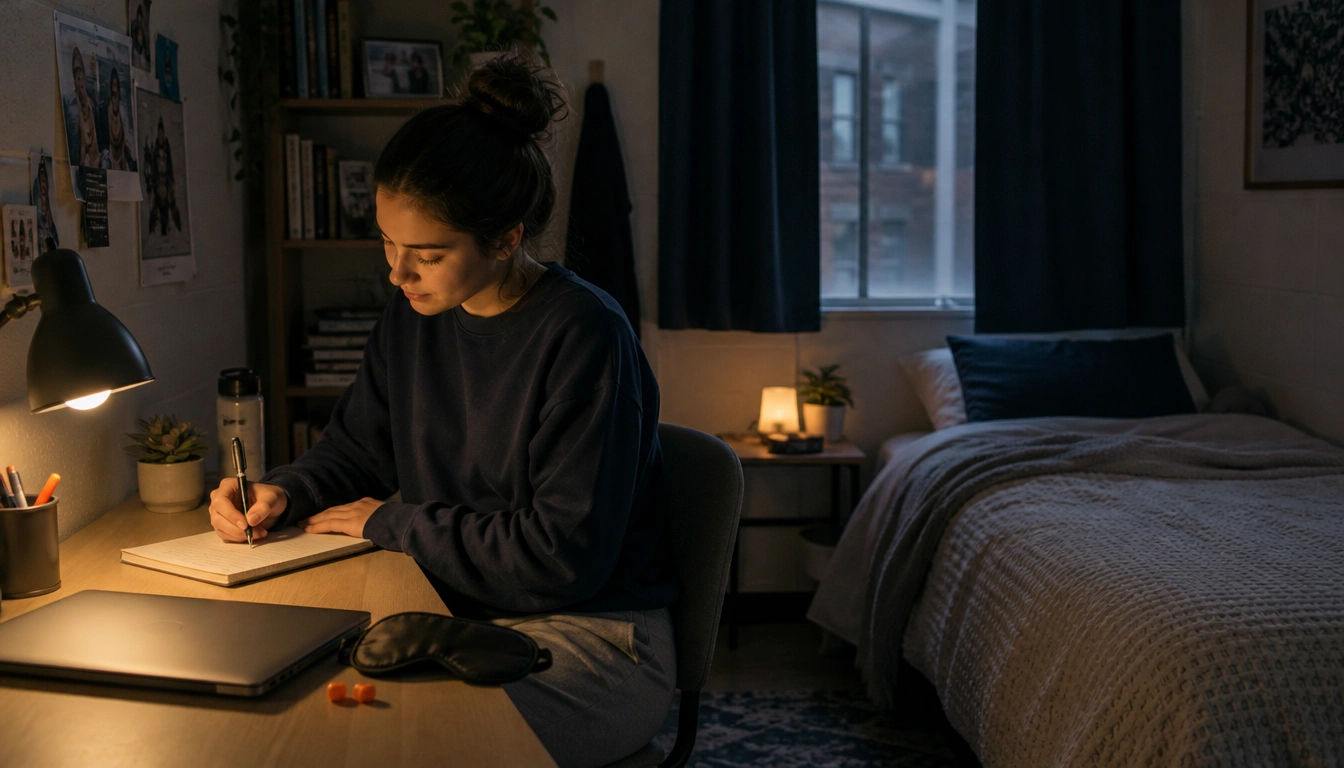
Yes—you can keep a realistic sleep routine during a busy college week by protecting the parts of sleep that stabilize your body clock and make rest more likely. The most useful habits are a consistent wake-up time, an evening buffer before bed, an earlier caffeine cutoff, and a plan for nights when stress keeps you awake. You do not need a perfect schedule to benefit from better sleep.
Key Takeaways
- A fixed wake-up time, kept within about an hour even on weekends, steadies your circadian rhythm better than trying to “pay back” sleep only on Sunday.
- For college students ages 18–25, major health guidance supports 7 to 9 hours of sleep per night for health, learning, and mood.
- If you are too wired to sleep, get out of bed after about 20 minutes and do something quiet and low-stimulation instead of lying there and ruminating.
- Dorm sleep is often an environment problem as much as a schedule problem; blackout curtains, earplugs, an eye mask, and dimmer device settings can help.
- Caffeine timing matters because its effects can linger for hours, so a practical afternoon cutoff usually helps more than vague advice to “avoid it late.”
Why busy college weeks hit sleep so hard
College sleep gets squeezed from both sides: deadlines push bedtime later, and early classes, labs, jobs, and activities pull wake time earlier. Add roommates, hallway noise, late-night screen use, and the pressure to keep studying when you are tired, and sleep becomes the first thing to slip.
That matters because sleep is not passive downtime. According to the CDC and the National Institutes of Health, sleep supports attention, learning, memory consolidation, mood regulation, and physical recovery. When you cut sleep repeatedly during exam week, you may feel like you are buying study time, but the cost often shows up as slower thinking, poorer recall, and worse focus the next day.
For most college students, the goal is not a flawless routine. It is a routine that is stable enough to keep your brain and body from sliding into constant sleep debt.
Why your body resists catch-up sleep alone
Sleeping in on weekends can feel restorative, but it does not fully undo a week of short sleep. The problem is not only the number of hours; it is also timing. Your body clock, or circadian rhythm, responds to regular cues, especially wake time, light exposure, meals, and activity.
When weekdays are short and weekends are very long, you can create social jetlag: your internal clock starts to drift as if you were changing time zones every week. That swing can make it harder to fall asleep on Sunday night and harder to wake up on Monday morning.
A fixed wake-up time within about a 1-hour window is often more stabilizing than trying to recover only on weekends. That does not mean every student needs the exact same schedule every day forever. It means that if you want your sleep to become easier, consistency at the start of the day is usually a stronger anchor than dramatic weekend shifts.
In practice, a smaller sleep-in is usually less disruptive than a big one. If you must sleep later after a rough night, try to keep the change modest and get back to your usual wake time the next day.
The simplest high-impact routine to protect sleep
If your week is overloaded, focus on the few habits most likely to move the needle. First, choose a wake time you can keep most days, including weekends if possible. Second, build a short wind-down buffer before bed, ideally 30 to 45 minutes, where studying stops and your brain gets a clear signal that the day is ending. Third, set a caffeine cutoff that gives stimulants time to wear off before sleep.
Caffeine can linger for hours, which is why “don’t drink it late” is too vague to be useful. A practical afternoon cutoff works better because it gives you a concrete decision point. The exact time depends on your sensitivity, the amount you drink, and how late you usually go to bed, but the goal is the same: avoid letting caffeine steal sleep from the night you are trying to protect.
The wind-down buffer does not have to be elaborate. Turn off academic work, dim lights, silence nonessential notifications, and switch from high-alert tasks to low-stimulation routines. That transition helps your nervous system move out of study mode and into sleep mode.
How to decide what to protect first
When everything feels urgent, it helps to rank your priorities. Sleep duration matters, consistency matters, and study time matters, but they do not all have equal payoff when the week gets chaotic. The strongest starting point is usually consistency, because it improves the chance that your available sleep is actually restful.
If you have to choose, protect your wake time first, then protect a realistic bedtime window, then protect study time earlier in the evening. That order is not perfect for every student, but it keeps the schedule centered around the body clock instead of letting every deadline push sleep later.
It also helps to separate short-term crunch from chronic short sleep. A single late night is not ideal, but repeated nights of very short sleep tend to compound quickly. During finals week, a plan that preserves most of your usual sleep is usually better than one that looks productive on paper but leaves you mentally foggy the next day.
For many students, the most realistic standard is not “sleep exactly right.” It is “avoid making the worst choice when pressure is high.”
Dorm-friendly sleep fixes that do not require a perfect room
Shared housing makes sleep harder, but you do not need a perfect bedroom to improve it. Start with darkness. Blackout curtains can help if outside light leaks in, and an eye mask is a simpler backup when you cannot control the room. Small LED lights from chargers, routers, and electronics can also be surprisingly disruptive, so covering them or turning devices away from your bed can help.
Next, work on noise. Earplugs can reduce hallway and roommate noise, and a steady background sound may help some students sleep more comfortably in a busy dorm. If your room runs hot, use bedding that feels breathable and keep the room as cool as you reasonably can.
Also pay attention to what is in reach. If your laptop is beside the pillow, it is too easy to keep studying “just one more thing.” Put study materials out of arm’s reach before you get into bed so sleep is the path of least resistance.
These adjustments are not glamorous, but they are often more effective than waiting for your environment to become ideal.
What to do when stress keeps you awake
When your mind is racing about assignments, a to-do list, or the exam you did not finish preparing for, staying in bed awake can train your brain to associate the bed with stress. A more useful approach is the 20-minute rule: if you are still awake after roughly 20 minutes, get out of bed and move to a dim, quiet place.
Do something low-stimulation until you feel sleepy again. A physical book, light stretching, quiet breathing, or a simple non-screen activity is usually better than scrolling. The point is to avoid lying there replaying deadlines and mentally rehearsing what you still have to do.
A short brain-dump can also help. Before bed, write down the tasks, reminders, and worries that keep looping in your head. This does not solve the workload, but it can reduce the pressure to keep holding everything in working memory at the same time.
If you return to bed, keep the environment boring and consistent. That way, bed stays linked to sleep rather than rumination.
What to do when a short night is unavoidable
Sometimes exams, shifts, or campus events make a short night unavoidable. In that case, the goal is damage control, not perfection. A shortened night is usually less harmful than an all-nighter because total sleep deprivation tends to hit attention, reaction time, and memory much harder the next day.
That does not mean a short night is good, but it is generally a better compromise than trying to push through with no sleep at all. If you can, keep the night shorter rather than eliminating it entirely, and use the next day to return to your normal wake time instead of sleeping very late.
Strategic rest can also help. A brief nap earlier in the day may be useful if it does not interfere with that night’s sleep. Keep it short enough that you can still fall asleep later, and avoid turning one short night into a multi-day spiral.
Most importantly, do not let a single crunch night become the new routine. The more often all-nighters happen, the more your study schedule starts to depend on being sleep deprived.
When sleep problems need a clinician’s help
Busy weeks can explain some sleep disruption, but not all of it. Consider campus health or a clinician if you regularly take 30 minutes or more to fall asleep even when you allow enough time in bed, wake up frequently during the night, or feel unreasonably sleepy during the day.
Get checked sooner if poor sleep starts affecting safety, class performance, mental health, or your ability to function normally. Persistent insomnia, loud snoring with breathing pauses, panic at bedtime, or sleep problems that continue after your schedule calms down are worth evaluating.
If you are trying multiple sleep-hygiene changes and still cannot sleep, that is useful information, not a failure. It can mean there is an underlying sleep issue, stress disorder, mood issue, or circadian rhythm problem that needs more specific care.
In other words, a busy week can justify temporary sleep strain. It should not be the reason you ignore a sleep problem that keeps coming back.
Frequently Asked Questions
Is it better to keep a fixed wake-up time or a fixed bedtime during busy weeks?
A fixed wake-up time is usually the stronger anchor because it stabilizes your circadian rhythm and helps regulate bedtime over time. If your schedule is chaotic, keep wake time as steady as possible and aim for a realistic bedtime window rather than forcing an exact bedtime that is impossible to maintain.
How much sleep do college students actually need to function well?
For healthy young adults ages 18–25, major public health and sleep organizations support 7 to 9 hours per night. Some people feel okay with slightly less on an occasional night, but regular sleep below that range tends to hurt attention, mood, learning, and recovery.
Is catching up on sleep over the weekend enough to fix a week of short sleep?
Weekend catch-up can help you feel a bit better, but it does not fully erase the effects of a week of short sleep or fully reset your body clock. Large sleep-ins can also create social jetlag, which makes Monday nights harder and can keep the cycle going.
What should I do if I can’t fall asleep because I’m stressed about schoolwork?
Get out of bed if you are awake for about 20 minutes and do a quiet, low-stimulation activity in dim light. A short brain-dump on paper can help unload tasks and worries. Try not to stay in bed ruminating, because that can strengthen the link between bed and stress.
How late is too late for caffeine if I need to study at night?
There is no single cutoff that works for everyone, but caffeine can last for hours, so an afternoon cutoff is usually more practical than vague advice to avoid it late. If you know caffeine keeps you awake, move the cutoff earlier on days when you need sleep more than extra stimulation.
The Bottom Line
A realistic college sleep routine is built on a few steady habits, not a perfect schedule. Keep wake time consistent, give yourself a short wind-down period, and set a caffeine cutoff that protects the night you are trying to preserve.
If stress keeps you awake, do not stay in bed battling your thoughts. Get up, reset in low light, and return to bed when sleepy. If sleep problems keep happening even when your schedule settles down, campus health or a clinician can help sort out whether something more than exam stress is going on.
Medical disclaimer
Medical disclaimer: This content is for educational and informational purposes only and is not a substitute for professional medical advice, diagnosis, or treatment. Dietary needs and supplement suitability vary by individual.
Sources
- Centers for Disease Control and Prevention (CDC) — cdc.gov. Accessed November 2026.
- National Institutes of Health (NIH) — nih.gov. Accessed November 2026.
- National Institutes of Health (NIH) — nih.gov. Accessed November 2026.
- Academic Research Institution — colostate.edu. Accessed November 2026.
