
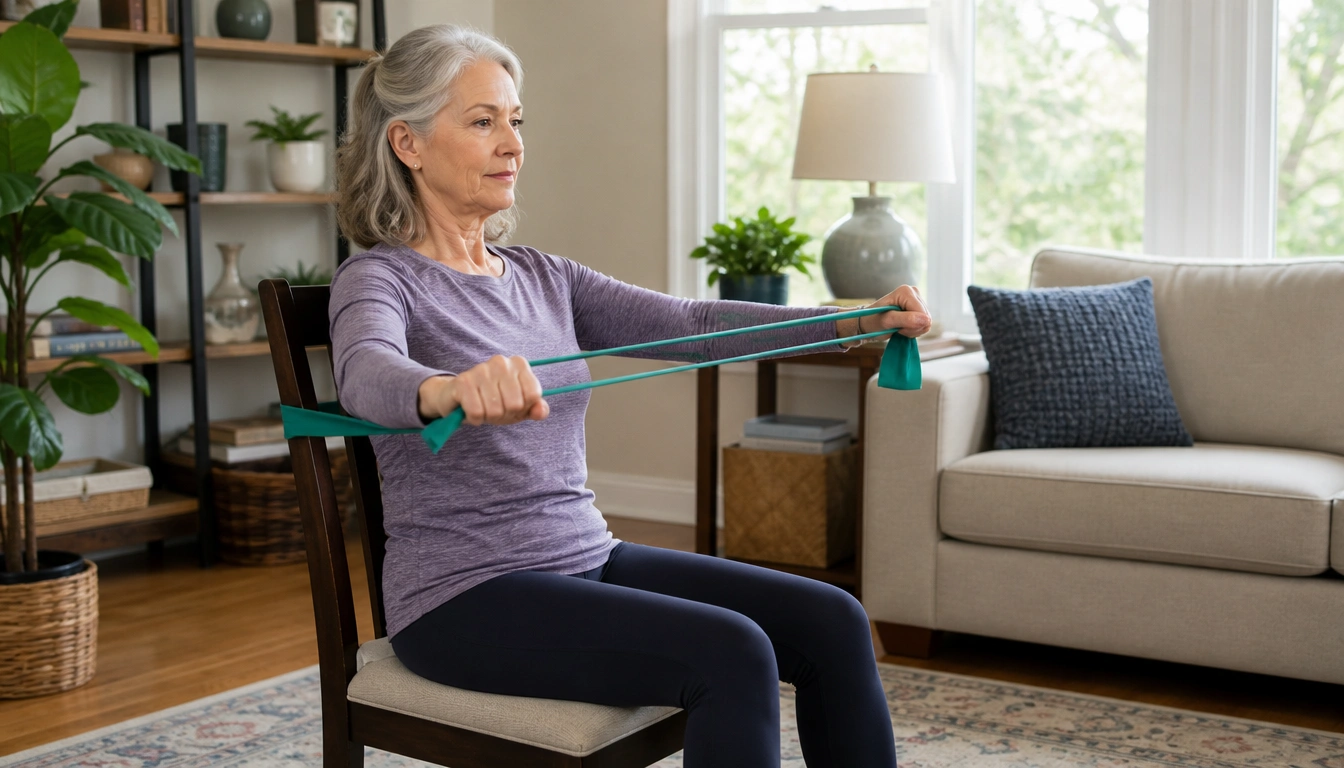
Yes—one of the best beginner strength routines after 50 is a simple full-body resistance band workout done at home twice a week. Bands can support strength, muscle size, and physical performance when used consistently, while staying joint-friendly and easy to scale. A good starter routine includes push, pull, squat, and arm/shoulder work, with careful attention to breathing, band safety, and balance-friendly setup.
Key Takeaways
- Resistance bands can deliver meaningful strength and function benefits after 50, especially when training is consistent and the effort is moderate.
- A beginner routine should train major movement patterns: push, pull, squat, and arm/shoulder work.
- Choose a band that feels challenging near the end of each set, but still lets you keep good form and steady breathing.
- Seated versions can make the routine safer and more comfortable for people with balance limits or joint irritation.
- Twice-weekly training, paired with a simple daily cue, is usually easier to maintain than a more complicated plan.
Why resistance bands fit well after 50
Resistance bands are a practical choice for adults over 50 because they are inexpensive, portable, and easier to store than most home equipment. They can also feel friendlier on joints than heavier free weights, since the load changes gradually as the band stretches. That makes them useful for people returning to exercise, managing mild arthritis, or building confidence after time away from strength training.
According to the Centers for Disease Control and Prevention, muscle-strengthening activity should target all major muscle groups at least two days per week. The American College of Sports Medicine also recognizes elastic bands as a valid way to improve strength and physical performance. In practice, that means a band routine is not a “lesser” option—it is a real strength stimulus that can fit into a home setting.
The other advantage is adherence. A routine you can do in a living room, bedroom, or hallway is easier to repeat. For many older beginners, the best program is the one that stays simple enough to do consistently.
What this routine is designed to improve
A good starter plan after 50 should support more than muscle size alone. It should help with the movements that matter in daily life: standing up from a chair, climbing stairs, carrying groceries, walking with steadier steps, and recovering balance if you trip or turn quickly.
Resistance training helps preserve muscle mass and can improve neuromuscular control in the hips, knees, and ankles. Those stabilizing muscles are part of what helps you stay upright when your balance is challenged. Bands can also provide a useful bone-loading stimulus, which matters because bone density tends to decline with age.
That does not mean a band workout is a cure-all or that it replaces medical care. It means the routine is built around functional outcomes: better chair stands, stronger pushing and pulling, more confidence on stairs, and more stability during everyday movement.
How to choose your starting band and effort level
Start with a light or medium band if you are new to resistance training or returning after a break. The right band is the one that lets you finish the set with control while feeling like the last few repetitions are clearly harder than the first few. You should not have to strain, jerk, or hold your breath.
A useful check is this: if you can do well over 15 repetitions with no loss of form, the band is probably too easy. If you cannot complete the target reps without leaning, shrugging, or losing control, it is too hard. The American College of Sports Medicine commonly uses a moderate-repetition range for starting strength work, and the final reps should feel moderately challenging.
For many people, progression does not mean making the routine more complex. It often means using a thicker band, holding the band a little shorter to increase tension, or moving from seated to standing once the seated version feels easy and stable.
The starter routine and how to do each movement
This beginner resistance band routine uses four core patterns: push, pull, squat, and arm/shoulder work. Do the exercises in a calm, controlled way. Rest briefly between sets, and keep your focus on smooth motion rather than speed.
Seated or standing chest press
Setup: Sit tall in a sturdy chair or stand with feet hip-width apart. Bring the band around your upper back and hold one end in each hand at chest height. Action: Press your hands forward until your elbows are almost straight, then return slowly to the start. Breathing: Exhale as you press, inhale as you return. Common mistakes: shrugging the shoulders, arching the lower back, or locking the elbows.
Seated or standing row
Setup: Sit with legs out or stand with a soft bend in the knees. Anchor the band around the feet or another secure point at about midfoot height. Action: Pull the elbows back alongside the body and gently squeeze the shoulder blades together, then return with control. Breathing: Exhale on the pull, inhale on the return. Common mistakes: leaning too far back, rounding the shoulders, or yanking the band.
Chair squat or sit-to-stand
Setup: Stand in front of a sturdy chair with feet about shoulder-width apart. You can hold the band for light resistance if you are comfortable, or practice without load first. Action: Sit back as if reaching for the chair, then stand by driving through the feet and legs. Keep the knees tracking in line with the toes. Breathing: Exhale as you stand, inhale as you lower. Common mistakes: collapsing the knees inward, dropping too quickly, or using momentum instead of leg strength.
Biceps curl with a gentle shoulder option
Setup: Stand or sit on the band so it is secure under one or both feet. Hold the ends with palms facing forward. Action: Curl the hands toward the shoulders without letting the elbows drift forward. If you want a shoulder emphasis, add a light front raise only if it feels smooth and pain-free. Breathing: Exhale during the lift, inhale on the lower. Common mistakes: swinging the body, pinching the shoulders, or using so much resistance that the neck tenses up.
For most beginners, one set of each exercise can be enough to start. The goal is to learn the pattern first, then build volume later. If your form is steady, the routine should feel challenging but manageable.
Seated and standing options for comfort and balance
Not everyone over 50 starts with the same balance, joint comfort, or confidence level. That is why the same routine should work in both seated and standing versions. Seated exercise is often a smart first step if you feel unsteady, have a history of falls, or simply want more control while learning.
A seated version can also reduce stress on painful knees, hips, or ankles. Use a sturdy, non-rolling chair and keep both feet grounded whenever possible. From there, you can progress one exercise at a time into standing if balance improves.
Standing versions offer more carryover to real-life movement because they ask your core, hips, and ankles to work together. If standing feels safe, keep a hand near a wall or counter for confidence. The best option is the one that lets you move well without fear, rushing, or pain.
Weekly schedule and progression plan
For most adults over 50, start with two training days per week, leaving at least one day between sessions. That spacing gives your muscles and connective tissue time to recover while making the habit easier to remember. A simple approach is 2 sets of 10 to 12 repetitions for each exercise, with about 30 to 60 seconds of rest between sets.
If you are just getting started, one set for the first week or two is also reasonable. Once the routine feels familiar, move to the fuller plan. Progress when the last few reps no longer feel moderately challenging and your form stays clean. You can increase difficulty by using a thicker band, shortening your grip, adding a second set, or moving from seated to standing.
Progress should feel gradual, not dramatic. If you need to brace, grunt, or compensate, the band is probably too heavy for that exercise right now. A safer progression is small and repeatable.
Safety checklist before every session
Before you begin, inspect the band for small tears, cracks, dry rot, or damage at the handles and anchor points. Replace any band that looks worn. Make sure your anchor point is solid and will not slip, tip, or snap back toward your face.
During the exercise, breathe continuously. Exhale through the hard part of the movement and inhale on the return. Avoid holding your breath, which can create an unnecessary spike in pressure. This matters especially for people with high blood pressure or anyone prone to straining.
Use pain as a boundary, not a test. Mild effort and muscle fatigue are normal; sharp pain, joint catching, dizziness, chest discomfort, or a sudden feeling of instability are not. Stop if your symptoms change in a worrying way, and seek medical guidance when needed. If you have severe balance problems, unstable joint issues, or a recent injury, ask a healthcare professional or physical therapist before starting.
How to make the routine stick
The most effective routine is the one you actually repeat. Pair your band workout with an existing cue, such as after morning coffee, after a walk, or before your shower on two set days each week. That habit stacking reduces the mental effort of deciding when to exercise.
Keep the sessions short enough to feel realistic. A focused 15- to 25-minute routine is often enough for a beginner. You do not need a complicated split or a large amount of equipment to make progress.
Recovery also matters. Drink water regularly through the day, and include protein across meals to support muscle repair. After 50, strength gains come from repeated practice plus recovery, not from one intense session. Simple, steady effort tends to win.
Frequently Asked Questions
How often should adults over 50 do resistance band workouts?
A good starting point is twice per week, with at least one day between sessions. That matches public health guidance for muscle-strengthening activity and gives you time to recover. As the routine gets easier, you can keep the same schedule and gradually increase the challenge.
What exercises should be in a simple full-body resistance band routine?
A simple routine should cover the main movement patterns: a push exercise, a pull exercise, a squat or sit-to-stand, and an arm or shoulder movement. Those patterns help train the muscles used for standing up, carrying, reaching, and stabilizing your body.
How do I choose the right resistance band strength as a beginner?
Choose a light or medium band that lets you do the target repetitions with control. The last few reps should feel clearly harder, but you should still be able to breathe normally and keep good form. If you can do far more than the target reps, move up in resistance.
Can resistance bands help with balance, falls, and bone health?
They can help support the muscles and movement patterns that matter for balance, such as the hips, legs, and trunk. Resistance training also provides a loading stimulus that supports bone health. It is not a guarantee against falls, but it can be part of a stronger, steadier body.
What safety precautions should I follow before starting band exercises?
Check the band for wear, use a secure anchor point, and keep breathing during each rep instead of holding your breath. Start with movements you can control, and stop if you get sharp pain, dizziness, chest discomfort, or a sudden loss of balance. If you are unsure, get medical clearance first.
The Bottom Line
A beginner resistance band routine after 50 can be simple, effective, and easy to keep up at home. If you focus on a few core movements, use a band that feels moderately challenging, and train twice a week, you can build strength that supports everyday life.
The safest plan is the one that matches your current balance, joint comfort, and confidence. Start seated if needed, progress slowly, and keep the routine tied to a regular weekly cue so it becomes part of your normal schedule rather than another chore.
Medical disclaimer
Medical disclaimer: This content is for educational and informational purposes only and is not a substitute for professional medical advice, diagnosis, or treatment. Dietary needs and supplement suitability vary by individual.
Sources
- Centers for Disease Control and Prevention (CDC) — cdc.gov. Accessed October 2026.
- Centers for Disease Control and Prevention (CDC) — cdc.gov. Accessed October 2026.
- Centers for Disease Control and Prevention (CDC) — cdc.gov. Accessed October 2026.
- American College of Sports Medicine (ACSM) — acsm.org. Accessed October 2026.
