
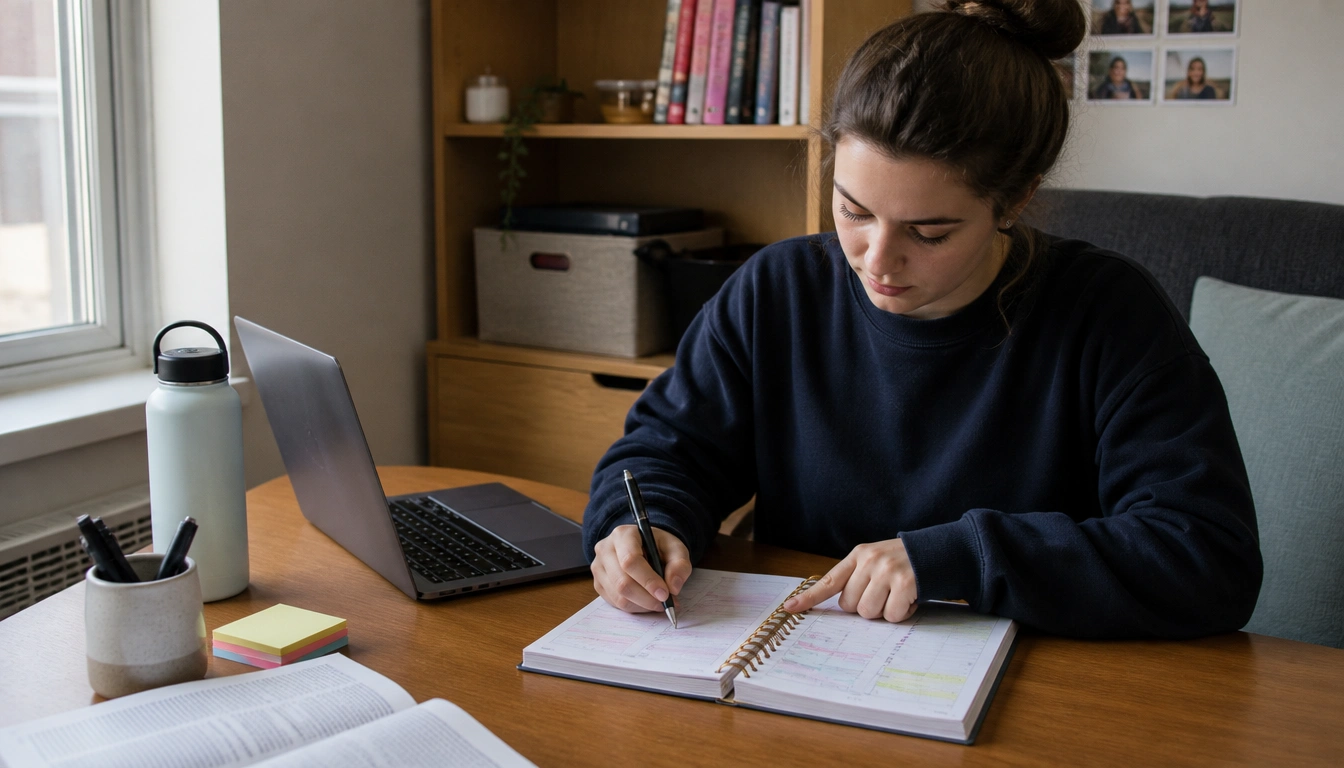
A stress-aware college schedule starts with anchors such as wake time, classes, meals, study blocks, and sleep, then adds buffers so the day does not run on the edge. Instead of packing every hour, build around your energy, protect recovery time, and use flexible study blocks for your hardest work. That approach can reduce the time-management stress loop that makes students feel behind even when they are busy.
Key Takeaways
- Start with nonnegotiables first: sleep, classes, meals, commute time, and a short wind-down. Build the rest around them.
- Leave 10 to 15 minute buffers between commitments so transit, transitions, and mental reset time do not turn into hidden stress.
- Match task difficulty to your energy: use your clearest hours for deep work and lower-energy windows for email, errands, and admin tasks.
- Break study time into focused blocks with real recovery breaks so attention does not drift and burnout does not build.
- Adjust the plan for your role and season of school life; first-year students, working students, and student-athletes need different kinds of flexibility.
- If stress includes severe insomnia, panic, hopelessness, or an inability to function, schedule changes are not enough—get campus or medical support.
Why a stress-aware schedule works
A stress-aware daily schedule for college students works because it reduces the time-management stress loop: when you feel little control over your day, procrastination becomes more likely, deadlines pile up, sleep gets shorter, and anxiety rises. That can hurt memory, concentration, and performance, which then makes the next day feel even more rushed. A schedule that lowers stress is not just about discipline. It is about building a day that your brain and body can actually carry.
Strict time-blocking often backfires when it leaves no room for delays, transitions, or the mental effort it takes to switch tasks. Start with anchors first: wake time, first class, meals, study blocks, exercise or movement, wind-down, and sleep. Once those are in place, add everything else around them. For many students, the most helpful change is not a more detailed planner; it is fewer assumptions that every minute will go perfectly.
Buffers matter. A 10- to 15-minute gap between classes, study sessions, or work shifts gives you transit time, a bathroom break, a snack, or just a mental reset. Without buffers, the day feels like one long catch-up exercise. The CDC recommends regular physical activity and healthy sleep habits as part of overall well-being, and those habits are easier to maintain when your schedule is not chronically overbooked.
Match task type to energy level
Not every task deserves your best hours. Deep work includes reading hard material, writing papers, problem-solving, and preparing for exams. Shallow or admin work includes answering messages, organizing notes, checking assignment portals, and filling out forms. Recovery includes walking, eating, stretching, praying, resting, or sitting quietly without screen noise. A stress-aware schedule places the heaviest cognitive work when your alertness is strongest and saves lower-demand tasks for less focused windows.
Many students assume the day should start with their hardest work, but that is not always true. Chronotype matters. Some people think most clearly in the morning, while others are much sharper later in the day. If your classes are fixed, use flexible tasks during low-energy periods and reserve your strongest focus window for the work that actually needs it. The goal is not to force every student into the same rhythm. It is to reduce friction between your brain’s natural pattern and your calendar.
As a practical rule, avoid stacking only high-effort tasks back to back. That creates mental fatigue and increases mistakes. Mix one demanding block with one lighter block, or pair focused study with a routine task afterward. This helps preserve attention without letting the whole day feel like a marathon.
Study rhythms that protect focus
A simple structure like the 50/10 rhythm can make studying feel more manageable. Work with full attention for about 50 minutes, then take about 10 minutes away from the material. For some students, a shorter Pomodoro-style cycle works better. The exact timing matters less than the pattern: focus hard, then recover on purpose. That is different from scrolling on your phone while telling yourself you are taking a break.
Good breaks actually restore attention. Stand up, stretch, drink water, step outside, look at something far away, or do a quick breathing exercise. If your break keeps your brain in the same overstimulated state, it is not really a reset. The American Psychological Association and NIH-supported guidance both support relaxation practices and stress-reduction habits as part of healthy coping. A break should lower cognitive load, not replace one kind of mental strain with another.
To avoid burnout, set a stop point for the day. Many students keep studying because they feel behind, not because another hour is useful. Past a certain point, fatigue lowers efficiency and retention. A better strategy is to protect your most productive hours, then end with a short review, a plan for tomorrow, and a hard transition into sleep preparation.
Daily anchor habits that lower stress
Anchors are the habits that give the day a stable shape. Morning light, water, breakfast, movement, and an evening digital sunset can all support stress regulation. They are not magic fixes, but they make it easier to think clearly and sleep on time. Consistent wake and sleep timing also supports circadian rhythm, which helps with alertness during the day and recovery at night.
Morning light is especially useful if you struggle to wake up or feel foggy early in the day. Hydration and breakfast can reduce the feeling of running on empty, especially on long class days. If campus food access is inconsistent, keep easy options available so you do not go too long without eating. Irregular meals can make energy and mood less stable, which often gets mistaken for laziness or low motivation.
Movement does not need to be a full workout to help. A walk between classes, a short stretch, or a few minutes of mobility can interrupt stress buildup. At night, a digital sunset gives your brain a chance to downshift. Turn down bright screens, review tomorrow’s plan on paper, and prepare what you need for the next day. The point is to offload mental clutter so sleep is not competing with a flood of unfinished thoughts.
How to adapt the schedule for different student types
First-year students usually need more structure, not more ambition. The first semester can bring culture shock, homesickness, and a lot of new logistics. A predictable routine helps reduce decision fatigue. That often means fewer open-ended plans, earlier planning for meals and laundry, and extra time to learn how long routine tasks really take.
Upperclassmen and graduate students often face a different problem: bigger projects with less visible progress. Thesis work, applications, lab responsibilities, and career pressure can make a day feel vague unless it has protected project blocks. For these students, the schedule should include uninterrupted time for deep work, not just class attendance and short study sessions.
Working students need micro-scheduling. If free time is limited, use small pockets for flashcards, reading summaries, planning, or administrative tasks. Student-athletes also need to plan around practice, travel, recovery, and nutrition. In both cases, the schedule should be realistic about what can fit into the day instead of pretending every hour is equally available.
Across all groups, the same idea applies: the schedule should fit the life you actually have, not the life you wish you had on a calm week in September.
How to adjust for chronotype and real-life constraints
If you are a morning person, use that window for the task that requires the most concentration. If you are a night owl, do not automatically assume early morning is your best study time. The best schedule is the one that respects your peak alertness while still protecting sleep. That may mean using lighter tasks early and saving harder work for later, as long as your sleep is not pushed so late that the next day collapses.
Commuting changes the math. Build in travel time, weather delays, and the transition time needed to shift from home mode to class mode. If campus demands vary from day to day, keep a flexible block that can absorb the unexpected. That may include office hours, group work, club meetings, or an assignment that got harder than expected. Without some slack, one surprise can derail the whole day.
Real life also means your schedule should account for bad days. If you slept poorly, had a panic-filled morning, or spent extra time dealing with a roommate issue, do not force the original plan exactly as written. Reduce the day to the essential priorities, move optional tasks, and protect sleep. Flexibility is not failure; it is what keeps a routine usable over the semester.
What a realistic stress-aware day can look like
A realistic college day does not need to be perfect to be useful. A student with morning classes might wake at a consistent time, get light and water, eat breakfast, and leave with enough time to avoid rushing. After class, they might use a buffer to decompress, then study a hard subject in a focused block while alertness is still decent. A lighter task can follow, such as checking messages or organizing notes.
Later in the day, a meal, movement, or a brief social break can function as recovery, not a reward that has to be earned. The evening can include one more focused study block if needed, followed by planning for tomorrow and a digital sunset before sleep. The exact order will change based on classes, work, and energy, but the structure stays the same: anchor, focus, recover, reset.
What makes this kind of day lower-stress is not the number of tasks. It is the spacing between them, the realism of the timing, and the fact that the plan leaves room to breathe. A student who can keep a routine even on imperfect days is usually better protected from the feeling of always being behind.
When scheduling is not enough
A better schedule can reduce stress, but it cannot treat a mental health condition. If stress is leading to severe insomnia, panic attacks, persistent hopelessness, thoughts of self-harm, or a complete inability to keep up with school or relationships, it is time to seek help. Campus counseling, student health services, and community mental health care can help you sort out whether what you are experiencing is ordinary overload or something more serious.
Pay attention to change over time. A rough week is common in college. A pattern of worsening sleep, constant dread, frequent crying, isolation, or inability to concentrate deserves attention. The NIH and CDC both emphasize the importance of stress management and seeking support when symptoms interfere with daily function. If your schedule keeps breaking down despite honest efforts to simplify it, that is a sign to bring in professional support rather than trying to optimize harder.
A schedule should help you function, not become another source of pressure. When the plan itself starts feeling punishing, the solution is usually to scale back, ask for help, and rebuild around the minimum structure you need to get through the week.
Frequently Asked Questions
What does a stress-aware schedule look like for a college student with classes all day?
It uses anchors and buffers instead of packing every free minute. Keep wake time, classes, meals, commute time, and a short study block visible first. Then add one or two focused work periods, recovery time, and a realistic wind-down so the day does not feel like a nonstop sprint.
How can I build in study breaks without losing productivity?
Use a planned work-rest rhythm such as about 50 minutes of focus followed by about 10 minutes of real recovery. During the break, stand up, stretch, drink water, or step outside. Try not to use the break for social media, which often keeps your brain just as overloaded.
What should first-year students do differently from upperclassmen?
First-year students usually benefit from more structure, simpler plans, and extra buffer time because so much of college is still unfamiliar. Upperclassmen and graduate students often need protected deep-work blocks for bigger projects, research, or career tasks that require longer, uninterrupted concentration.
How do working students fit a stress-aware schedule into limited free time?
Use micro-scheduling. Put smaller tasks into short gaps, like flashcards, reading, or planning between shifts and classes. Keep a few core anchors, then protect sleep and one realistic study block instead of trying to make every free minute productive.
How do I adjust my schedule if I’m a night owl or not productive in the morning?
Do not assume early morning is your best work time. Put lighter tasks in your low-energy window and save your hardest thinking for the time of day when you are naturally most alert. Just make sure your schedule still allows enough sleep and a consistent wake-up pattern.
The Bottom Line
A college schedule lowers stress when it is built around anchors, buffers, energy patterns, and recovery time instead of maximum output. The goal is not to look busy all day. It is to create a day you can actually repeat without constantly feeling behind.
If your routine keeps failing, simplify it before you add more productivity tools. And if stress is causing severe sleep problems, panic, hopelessness, or an inability to function, use campus counseling or medical support rather than trying to manage it with scheduling alone.
Medical disclaimer
Medical disclaimer: This content is for educational and informational purposes only and is not a substitute for professional medical advice, diagnosis, or treatment. Dietary needs and supplement suitability vary by individual.
Sources
- National Institutes of Health (NIH) — nih.gov. Accessed October 2026.
- National Institutes of Health (NIH) — nih.gov. Accessed October 2026.
- Centers for Disease Control and Prevention (CDC) — cdc.gov. Accessed October 2026.
- Centers for Disease Control and Prevention (CDC) — cdc.gov. Accessed October 2026.
- Academic Research Institution — tilburguniversity.edu. Accessed October 2026.
