
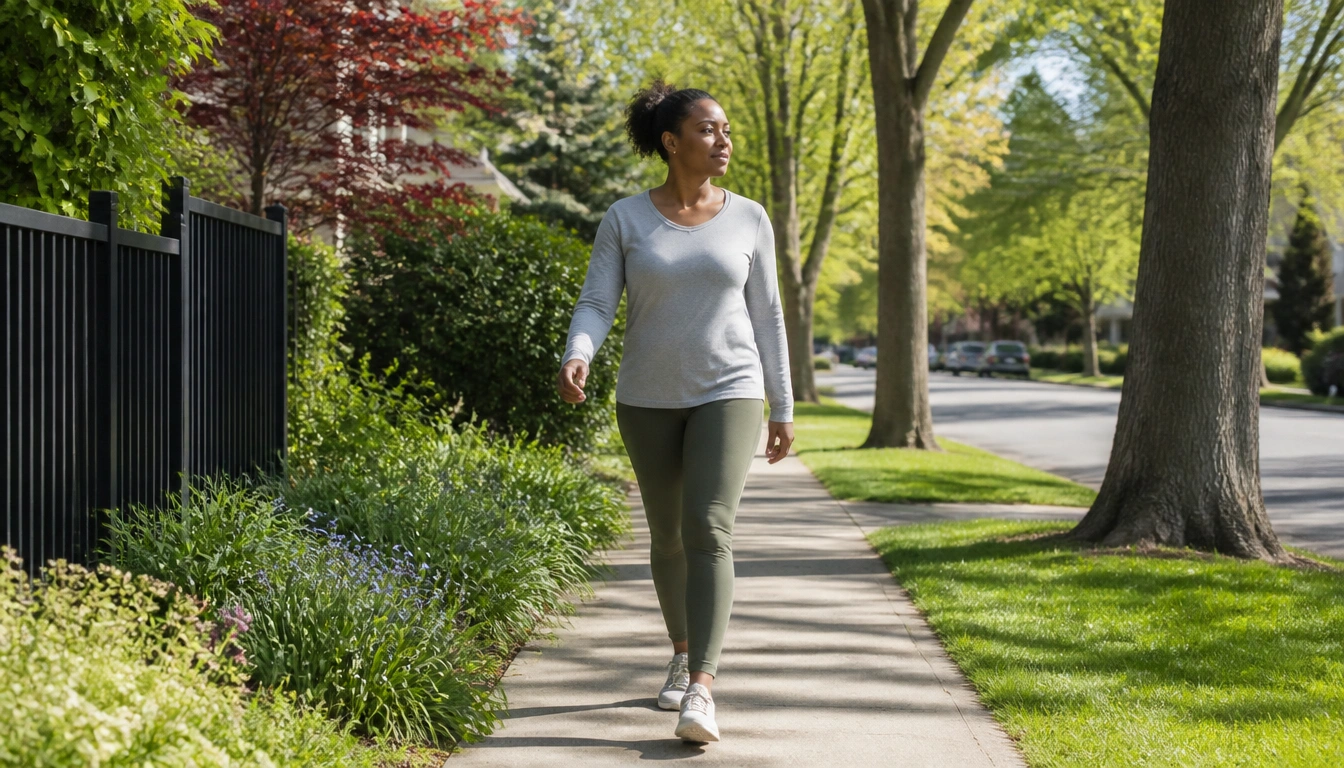
The simplest safe movement goal for many adults returning after inactivity is to start with 10 minutes of brisk walking once or twice a day, 3 to 5 days a week. That small goal is easier to repeat, helps rebuild confidence, and can grow toward public health targets over time. If you can comfortably talk while moving but not sing, you are likely in a moderate-intensity zone.
Key Takeaways
- Start smaller than the full weekly target if needed. Consistency matters more at first than reaching 150 minutes immediately.
- A 10-minute brisk walk is a realistic bridge back into exercise and can be repeated around normal routines.
- The talk test is a simple way to judge moderate intensity without a watch or fitness tracker.
- Strength work does not require a gym; chair sit-to-stands, wall push-ups, resistance bands, and carrying groceries all count.
- Adults 65 and older should add balance and stability work at least twice weekly to lower fall risk.
- Mild soreness can be normal when restarting, but sharp pain, chest symptoms, dizziness, or worsening shortness of breath need medical attention.
Why small movement goals work better than all-or-nothing plans
For adults returning to exercise after being inactive, the safest plan is usually the one you can repeat. A large workout target can feel motivating for a day and impossible by day four, especially if you are deconditioned, busy, or worried about soreness. A smaller goal lowers the barrier to starting and makes success more likely.
This matters because the first win is not fitness perfection. It is rebuilding the habit loop: decide, do, recover, repeat. Public health guidance from the CDC and the NHS both support the idea that some activity is better than none. That means an imperfect week still counts if it helps you move forward instead of quitting altogether.
Think of the restart phase as a bridge, not a finish line. You are not trying to prove endurance right away. You are trying to get your body used to movement again while keeping the effort manageable enough to come back tomorrow.
The simplest starter goal: a 10-minute brisk walk
A practical first goal is a 10-minute brisk walk once or twice a day, 3 to 5 days a week. That is enough to create structure without making the plan feel heavy. If a full workout feels unrealistic, 10 minutes gives you a clear start and a clear stop.
Brisk walking works well because it is familiar, low-cost, and easy to adjust. You can walk outside, indoors, around a store, or on a hallway loop. If 10 minutes feels too ambitious on a difficult day, begin with less and build up gradually. The aim is accumulation and consistency, not forcing the full weekly recommendation on day one.
Over time, these short sessions can add up toward the public health benchmark of 150 minutes of moderate-intensity activity a week. The bridge matters because people often succeed when the first step feels almost too easy to skip.
How to tell if you are moving at the right intensity
The easiest self-check is the talk test. During moderate-intensity movement, you should be breathing harder, feel warmer, and notice your heart working more, but you can still speak in full sentences. You should not be gasping. A simple phrase is “talk, but not sing.”
Other non-tech clues help too. Your breathing becomes deeper, your pace feels purposeful, and your body feels engaged without strain. If you are still unsure, it is usually better to begin a little easier than to start too hard. Early consistency matters more than proving fitness on the first week.
To make the habit repeatable, pair it with a cue you already do every day. This is cue-based stacking. For example: after lunch, after the school run, after logging off work, or after morning coffee. The cue is the reminder; the walk is the action. Keep the trigger simple and consistent so you do not have to negotiate with yourself each day.
A simple weekly structure that includes walking, strength, and recovery
A balanced restart week does not need to be complicated. One workable pattern is three to five short walking days, two light strength days, and recovery days in between as needed. Recovery does not mean doing nothing forever; it means giving sore or tired muscles time to adapt.
Strength training matters because it supports joint stability, posture, and everyday tasks. Public health guidance from the CDC recommends muscle-strengthening activities on at least two days a week. You do not need a gym to meet that standard.
Useful no-gym options include chair sit-to-stands, wall push-ups, resistance-band rows, calf raises, and carrying grocery bags with balanced weight. These movements train major muscle groups while fitting into normal life. You can also use stairs, countertop push-ups, or a loaded backpack if that feels comfortable and controlled. Start with modest effort and good form rather than chasing fatigue.
A simple pattern might look like this: walk on Monday, strength on Tuesday, rest or light walking on Wednesday, walk on Thursday, strength on Friday, and easy movement over the weekend. The exact days matter less than having a rhythm you can keep.
How to reduce sedentary time during the day
Short movement breaks matter even when you are not doing a formal workout. Long stretches of sitting can leave your body stiff and less alert, especially when you are rebuilding an activity habit. Breaking up sitting also makes the day feel less physically flat.
A good starting point is to stand up, stretch, or walk for a couple of minutes each hour. You do not need to make every break into exercise. A lap around the room, a few calf raises, a stretch by the desk, or a quick trip for water is enough to interrupt long sedentary spells.
These tiny resets work best when attached to something that already happens: after emails, after a meeting, after a TV episode, or whenever you refill your drink. If a full workout is not realistic yet, these brief breaks help keep movement present in the day.
Special situations: long inactivity, chronic conditions, older adults, pregnancy, and postpartum return
If you have been inactive for a long time, have a stable chronic condition, or notice symptoms like chest pain, unusual dizziness, or severe breathlessness, it is wise to speak with a healthcare professional before making a big jump in activity. Personalized advice matters more when there are medical risks or uncertainty about what your body can handle.
Older adults can follow the same general restart idea, but balance and stability work become especially important. The National Health Service recommends including balance work at least twice weekly for older adults to help reduce fall risk. Simple choices include standing on one foot while holding a counter, heel-to-toe walking, or gentle tai chi-style movements.
Pregnant and postpartum adults may also move safely, but the return should be individualized. Postpartum recovery often needs a gradual ramp-up, especially after a difficult birth, pelvic floor symptoms, or a long period of rest. If you are rebuilding after pregnancy, ask your clinician for guidance on timing and intensity, particularly if you have not yet had your postpartum check.
Whatever the situation, the same principle applies: start at the level that feels safe enough to repeat. Your first goal is not to outperform your old routine. It is to create a version of movement that matches your current health status.
Normal soreness versus warning signs that need attention
Some soreness after restarting exercise is normal, especially if your muscles have not been used much. Mild delayed-onset muscle soreness often shows up a day or two later and feels dull, stiff, or achy rather than sharp. It usually improves with light movement, rest, and time.
What is not normal is pain that is sharp, sudden, worsening, or linked to a specific injury. Stop and seek medical advice if you notice chest pain, faintness, severe shortness of breath, a racing or irregular heartbeat that feels wrong, major swelling, or pain that changes how you walk or use a limb. Those signs deserve attention rather than a push through.
A useful rule is this: soreness makes you aware of your muscles, but red-flag symptoms make you feel unwell or unsafe. If you are unsure, choose caution and get checked.
How to progress from a starter goal to public health targets
Once the 10-minute habit feels steady, progress gradually. You might first add another day, then extend one walk by a few minutes, then increase the pace slightly. The point is to make one small change at a time so your body and routine can adapt without overload.
It can help to think in layers. First, make movement regular. Next, make it slightly longer. Then make it a little more challenging. Over time, those changes can move you toward the weekly target of 150 minutes of moderate activity and two days of strength work.
Some weeks will be better than others. A busy week, illness, travel, or poor sleep may shrink your plan. That does not erase your progress. Returning to the starter goal for a few days is often smarter than abandoning the habit because the ideal week was not possible.
If you want a simple rule for progression, increase only when the current routine feels steady enough that you could do it again next week. That keeps the plan practical and reduces the chance of burning out.
Frequently Asked Questions
How many minutes of movement should I start with if 150 minutes a week feels unrealistic?
Start with something you can repeat, such as 10 minutes of brisk walking once or twice a day, 3 to 5 days a week. If that still feels like too much, begin with less and build up. The goal early on is consistency and accumulation, not matching the full weekly target immediately.
What counts as moderate-intensity movement when I’m getting back into exercise?
Moderate intensity usually means your breathing is faster, your body feels warmer, and your heart rate is up, but you can still talk in full sentences. If you can speak comfortably but cannot sing, you are likely in the right range for a beginner walk or similar activity.
Do I need strength training too, or is walking enough at first?
Walking is a great starting point, but strength work is also important for major muscle groups, joint support, and everyday function. You do not need a gym. Chair sit-to-stands, wall push-ups, resistance bands, and carrying groceries can all count as practical home options.
How do I restart movement if I have been inactive for a long time or have a chronic condition?
Start conservatively and consider checking with a healthcare professional first if you have a chronic condition, unexplained symptoms, or have been inactive for a long time. A slower pace, shorter sessions, and more recovery time may be appropriate. Individual guidance matters when medical issues are part of the picture.
What soreness is normal when restarting, and what warning signs mean I should stop and get medical advice?
Mild muscle soreness one or two days later is common and usually improves on its own. Stop and get medical advice if you have sharp pain, chest discomfort, severe shortness of breath, dizziness, fainting, major swelling, or pain that worsens instead of easing.
The Bottom Line
If you are returning to exercise after inactivity, the safest first goal is often the simplest one: a short, repeatable walk paired with a little strength work. You do not need to earn the right to start by being fit already.
Build from what you can do now, not from what a perfect week would look like. Use the talk test, choose a cue that already exists in your day, and progress only when the current habit feels steady. If symptoms feel unusual or unsafe, pause and seek medical advice rather than pushing through.
Medical disclaimer
Medical disclaimer: This content is for educational and informational purposes only and is not a substitute for professional medical advice, diagnosis, or treatment. Dietary needs and supplement suitability vary by individual.
Sources
- Centers for Disease Control and Prevention (CDC) — cdc.gov. Accessed October 2026.
- National Health Service (NHS) — www.nhs.uk. Accessed October 2026.
