
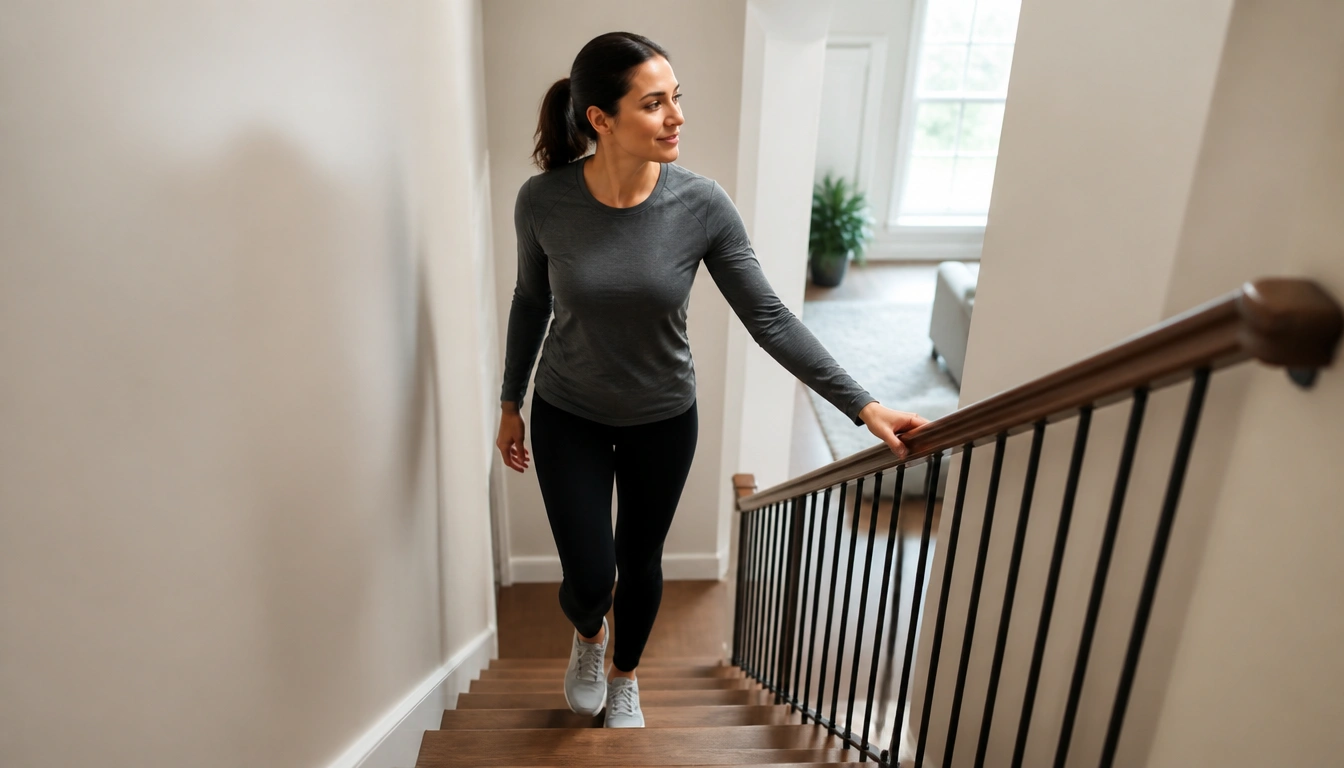
Yes—your home stairs can give you a strong workout if you use them with good form, sensible pacing, and attention to safety. For most adults, the best approach is to start with short stair-walking bouts, keep the pace controlled, and build up gradually over time. Use the talk test to judge intensity, and treat descent more cautiously than ascent, especially if you are a beginner or have knee or balance concerns.
Key Takeaways
- Stair walking is a time-efficient cardio and lower-body workout that can be done at home with no equipment.
- Going up stairs is mainly a power-and-cardio effort; going down adds more balance demands and eccentric muscle loading.
- Beginners and older adults usually do best by starting with one flight or part of a flight at an easy pace before increasing speed.
- Short stair “snacks” can count toward weekly activity goals if they add up to enough moderate or vigorous movement.
- A safe staircase matters: good lighting, dry steps, clear floors, and sturdy handrails are not optional details.
Why stair walking works so well at home
Stair walking is a practical home workout because it asks your body to lift its full weight against gravity. That makes it more demanding than walking on flat ground at an easy pace. According to physical activity research summarized by Harvard and the Compendium of Physical Activities, brisk stair climbing can reach vigorous-intensity effort quickly, which is why a short session may feel harder than a much longer flat walk.
The main muscles involved are the quadriceps, gluteals, hamstrings, and calves. Your heart and lungs also have to work harder to deliver oxygen during repeated climbs. For many people, that combination makes stairs a useful way to train both cardio fitness and lower-body strength at the same time.
There is an important difference between ascent and descent. Going up is mostly concentric work, meaning the muscles shorten as they push your body upward. Going down adds eccentric loading, where the muscles lengthen while controlling movement. That extra control challenge is one reason descent can improve coordination and balance, but it can also be harder on the knees and more risky if you are unsteady.
If you want a simple intensity check, use the talk test recommended in public-health guidance. At a moderate effort, you should be able to talk but not sing. At a vigorous effort, you may only manage a few words before needing a breath. That works well for stair sessions because you do not need a tracker or heart-rate monitor to get useful feedback.
A simple beginner stair-walking routine for home use
If you are new to exercise, your first goal is not speed. It is control, comfort, and consistency. A beginner stair walking routine at home should feel manageable enough that you can repeat it on another day without feeling wiped out.
Start with a brief warm-up such as marching in place or easy walking around the house. Then walk up one flight of stairs at a steady pace. Pause at the top if needed, then come down slowly and carefully. If one flight feels like too much, use a partial flight or even a few steps, then rest and repeat.
A good starting point is a few short repeats, with the total session kept brief. The exact number is less important than the pattern: climb, recover, repeat. If you can keep your breathing controlled and your form steady, you are probably in the right zone for a beginner session.
For many home exercisers, this kind of routine works well once or twice a day on a few days of the week. That makes it easier to build the habit without feeling like you need a long workout block.
Easy version: climb a short section slowly and hold the rail when needed. Harder version: climb a full flight with less pause and a smoother rhythm. Keep the movement crisp, but do not rush the steps.
How to build up with longer bouts, intervals, or stair snacks
Once a short stair routine feels comfortable, you can increase challenge in a few different ways. The safest progression is usually to extend duration before increasing speed. That means adding another repeat, a little more total time, or a slightly longer climb before trying harder intervals.
For people who are already active, stair snacks can be a useful strategy. These are brief bouts placed throughout the day, such as a few minutes before work, after lunch, or between tasks. Public-health guidance from the CDC and World Health Organization supports accumulating activity across the week, which means short sessions can help you move toward the goal of 150 minutes of moderate-intensity activity or 75 minutes of vigorous-intensity activity per week.
If you prefer structure, you can turn stairs into intervals. For example, climb at a moderate pace, recover for a short period, then repeat. Intervals are helpful because they let you train without needing a long continuous block. They can also make the workout feel more approachable than trying to stay at one steady hard pace for too long.
Older adults and beginners should be especially careful with progression. Start with one flight or part of a flight, keep the pace slow, and build duration first. Speed can come later. That approach lowers the chance that sore joints, fatigue, or loss of confidence will shut the routine down before it becomes a habit.
How to descend safely and when to modify or skip it
Descending stairs is not the same as climbing them. The lower body has to absorb and control your weight, which creates more eccentric stress and more balance demand. That is useful training, but it is also the part of stair work that most often needs modification.
If you are a beginner, have knee discomfort, or feel unsure on the stairs, use a cautious descent. Hold the handrail, keep your steps deliberate, and slow the pace enough that each foot is placed with intention. If that still feels uncomfortable, climb the stairs and recover by walking down very slowly, or choose another way to come back down if your home setup allows it.
People with knee osteoarthritis, a history of falls, joint instability, or a current injury may need to limit or skip descent at first. In those cases, the safer choice is often to focus on controlled ascent and use a separate flat-ground walk for additional volume. If descending causes pain that feels sharp, unstable, or worsening over time, stop and reassess rather than trying to push through it.
A useful rule is this: descent should feel controlled, not risky. If you cannot keep your balance without rushing or grabbing for support, the pace is too fast or the step pattern is too demanding for now.
The staircase safety checklist that matters most
A home staircase only works as exercise equipment if it is safe enough to use repeatedly. Before you start, check the basics every time, especially if you are exercising early in the morning, after chores, or when the house is busy.
- Lighting: Make sure the stairwell is bright enough to see each step clearly.
- Clutter: Remove toys, laundry, bags, cords, and anything else that could catch a foot.
- Handrails: Use sturdy rails if they are available, especially on the way down.
- Dry steps: Wipe up spills and avoid slippery surfaces.
- Footwear: Wear stable shoes or secure footwear with good grip rather than loose slippers.
These details may sound basic, but they are part of the workout plan. Poor lighting or clutter turns a useful exercise tool into a fall hazard. If your stairs do not feel stable enough for repeated use, use another home cardio option until the environment is improved.
For households with children or pets, timing matters too. Pick a quiet window if possible so you are not dodging movement while climbing. That improves both safety and focus.
Who should get medical advice before starting
Most healthy adults can try a gentle stair routine, but some people should talk with a healthcare professional first. According to the National Institutes of Health and common clinical guidance, that includes people with known cardiovascular disease, uncontrolled high blood pressure, frequent dizziness, balance problems, severe neuropathy, recent lower-body injury, joint replacement, acute pain that worsens on stairs, or major vision or depth-perception problems.
Medical advice is also wise if you have been inactive for a long time and are not sure how your body will respond to climbing. A clinician or physical therapist can help you adjust the pace, volume, and descent strategy so the routine matches your current function.
During exercise, stop immediately if you get chest discomfort, unusual shortness of breath, lightheadedness, sudden joint swelling, or sharp pain. Those are not signs to train harder; they are signs to pause and get checked if the symptom does not settle quickly.
If you already know that stairs irritate a joint or worsen your dizziness, choose a different activity until you have specific guidance. Safety comes before trying to force a stair habit.
How to fit stair walking into your weekly exercise plan
Stair walking is most useful when it supports your full weekly plan instead of replacing everything else. The public-health target for adults is still a mix of aerobic activity each week, and stairs can help you accumulate that total in short chunks.
You do not need to do stairs every day. A realistic schedule might include a few short stair sessions on busy days, a longer walk on other days, and at least some recovery time if your legs feel taxed. The point is to build a pattern you can repeat.
If your stair session feels moderate, it can count toward your weekly aerobic minutes at a lower intensity. If it feels vigorous, you may need less total time to contribute to the weekly target. The talk test helps you decide which category your workout fits into.
Try pairing stairs with a consistent daily cue. For example, you might do a short climb after a morning meeting, before lunch, or after putting away your work bag. Habit pairing makes the workout easier to remember and less dependent on motivation.
If you want lower-body strength as well as cardio, keep some sessions slower and controlled. If you want more cardiovascular challenge, add short intervals or a longer total session. That kind of variety can help you avoid boredom without making every workout hard.
Common mistakes that make stair workouts less effective
The most common mistake is rushing. Fast feet do not automatically mean better training, and rushing increases the chance of missing a step. Controlled movement usually gives you a better workout and safer mechanics.
Another mistake is skipping the warm-up. Even a brief transition from sitting to climbing can help your body prepare. Marching in place, gentle hip movement, or a short flat walk can make the first climb feel smoother.
Poor footing is another problem. Wearing unstable shoes, descending too quickly, or using a cluttered stairway can turn a useful routine into a risky one. If the footing is questionable, slow down or stop.
Finally, do not ignore pain. Mild effort and breathlessness are expected; sharp pain, knee pain that worsens as you continue, or persistent discomfort after the session is different. Modify the routine, reduce descent, shorten the session, or seek advice if the issue keeps returning.
The best stair routine is the one you can repeat safely. Small, consistent sessions usually beat occasional hard efforts that leave you sore, worried, or off balance.
Frequently Asked Questions
How long should a beginner stair workout be at home?
Start short enough that you feel confident repeating it. For many beginners, that means one flight or part of a flight for a few rounds, with rests as needed. The total session may only last a few minutes at first, and that is fine if your form stays controlled.
Is walking stairs up and down equally good, or should I avoid descending?
Going up and down are not the same. Ascent is the main cardio and leg-strength challenge, while descent adds more balance demand and eccentric loading. If you have knee pain, poor balance, or a fall history, it is reasonable to modify or limit descent.
How do I know if my stair workout is moderate or vigorous intensity?
Use the talk test. If you can talk but not sing, the effort is usually moderate. If you can only say a few words before needing a breath, it is closer to vigorous. This is a practical way to judge intensity without equipment.
Can stair walking help with cardio fitness and leg strength?
Yes. Stair climbing raises your heart rate and works the major muscles of the legs and hips at the same time. Research and exercise guidance support it as a useful home option for improving conditioning, especially when done consistently over time.
Who should not start a stair routine without medical advice?
People with heart disease, uncontrolled blood pressure, frequent dizziness, balance problems, severe neuropathy, recent lower-body injury, joint replacement, acute pain on stairs, or major vision problems should check with a clinician first. If symptoms worsen during exercise, stop and get evaluated.
The Bottom Line
A home stair routine can be an efficient way to train your cardio fitness, legs, and balance without equipment. The safest approach is to start small, keep your pace controlled, and use the talk test to judge how hard you are working.
Treat ascent and descent differently. Climbing is the main conditioning work, while descending needs more caution because it places extra demands on the knees and balance system. If your stairs are cluttered, dark, slippery, or rail-free, fix the setup before making stairs your workout.
A few short sessions each week can fit into a realistic home plan, and stair snacks can help you accumulate activity toward public-health goals. If pain, dizziness, or instability shows up, scale back and get medical guidance when needed.
Medical disclaimer
Medical disclaimer: This content is for educational and informational purposes only and is not a substitute for professional medical advice, diagnosis, or treatment. Dietary needs and supplement suitability vary by individual.
Sources
- National Institutes of Health (NIH) — nih.gov. Accessed October 2026.
- Academic Research Institution — harvard.edu. Accessed October 2026.
