
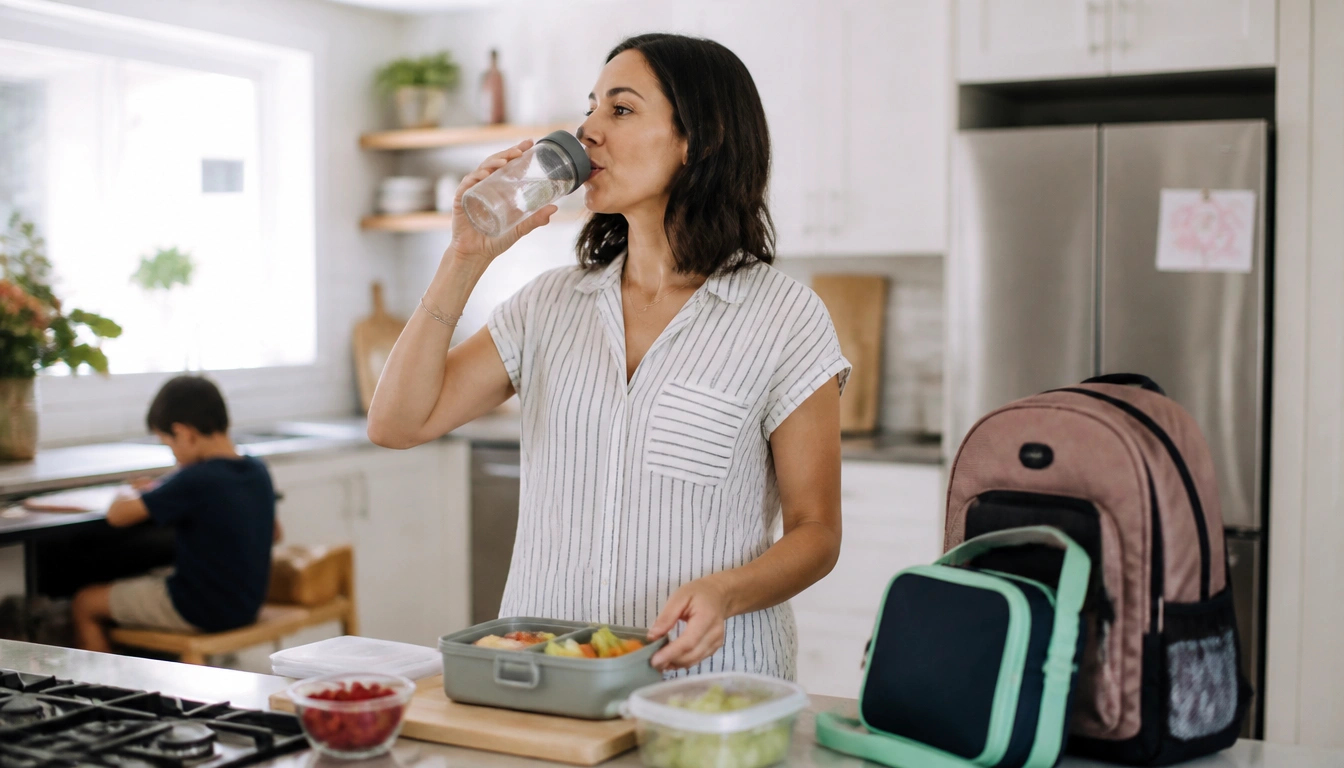
Busy parents usually do best with a simple hydration system built around existing routines, not a reminder app or a rigid ounces target. Pair drinking water with repeated daily moments like school drop-off, meals, and bedtime, keep water visible and within reach, and use water-rich foods as backup. You can also use urine color and how you feel to check hydration without tracking every sip.
Key Takeaways
- Pair water with routines you already do, such as waking up, school runs, meals, and bedtime, so hydration becomes automatic.
- Exact ounces matter less than consistency. Official guidance supports regular fluid intake, but needs vary by body size, activity, heat, pregnancy, and breastfeeding.
- Water-rich foods such as fruit, vegetables, soup, and yogurt can meaningfully add to daily fluid intake when you fall behind.
- Coffee and tea can count toward fluid intake, but they should complement, not replace, water and other hydrating options.
- Pale straw or light yellow urine is a practical at-home check; dark yellow urine often means you need more fluids.
- Too much water can also be a problem, especially if you drink large amounts very quickly or have a medical condition that changes fluid needs.
Why hydration gets missed in busy caregiving routines
For many parents, drinking enough water is not hard because they do not care about it. It gets missed because caregiving is full of interruptions. You are helping with shoes, packing lunches, answering questions, loading the car, and switching between work and home. In that kind of day, thirst can be ignored until it shows up as headache, fatigue, dry mouth, or a foggy feeling.
A useful hydration plan for parents should fit the way family life actually works. That means using routine pairings, easy access, and backup options instead of depending on memory alone. The goal is not a perfect number on a tracker. The goal is to drink often enough that hydration becomes part of the day rather than one more task to manage.
That approach also helps when a parent is caring for children who have their own schedules. If your own needs wait until the end of the day, you are more likely to fall behind. A small, repeatable plan works better than trying to catch up all at once later.
Simple daily fluid guidance without counting every ounce
Official guidance gives a broad target, but it is meant as a baseline, not a test. The NHS commonly recommends about 6 to 8 cups or glasses of fluid a day for many adults, and other public health guidance recognizes that total fluid needs vary with age, sex, body size, activity, climate, and life stage. The National Academies also note that daily fluid intake includes beverages and water from food, not just plain water alone.
That is why exact ounces are less important than steady intake across the day. A busy parent does not need to measure every sip to benefit from a good habit plan. For many people, the practical question is not, “Did I reach a perfect number?” It is, “Did I drink regularly enough to stay comfortable, focused, and not play catch-up at night?”
Think in terms of baseline consistency. If you routinely start the day with no fluid, skip water through the afternoon, and only drink once you feel depleted, you are more likely to feel it. A simpler rhythm is better: a little in the morning, a little at transitions, and a little with meals.
Build a parent-friendly hydration plan around repeatable cues
The easiest water habit for busy parents is usually not “drink more.” It is “drink when something else already happens.” Pairing hydration with existing routines lowers the mental load and makes follow-through more reliable than willpower alone.
Choose three to five cues you already do most days. Good examples include waking up, making breakfast, school drop-off, returning home, lunch, afternoon pickup, dinner prep, and bedtime. Each cue becomes a short drink moment. You do not need a long pause. A few good swallows each time can be enough to keep the habit moving.
Many parents find it helpful to connect their own drink with a child-related moment. When you pour milk or prepare a water bottle for a child, fill yours too. When you sit down for snack time, take a drink. When you arrive at practice or wait in the car line, use that pause to sip. This works because it uses the rhythm of caregiving itself as the reminder.
Environment matters too. Keep a reusable bottle where you will see it: on the counter, beside the coffee maker, on your desk, by the diaper bag, or in the car cup holder. At home, at work, and on the go, make water easy to reach before you feel thirsty. If plain water is hard to drink, try chilled water, sparkling water, ice, lemon, cucumber, or mint. The point is to make the choice easy enough that it happens without extra effort.
Use food-first backup hydration and choose drinks wisely
When drinking falls behind, food can help fill the gap. Many fruits and vegetables contain a lot of water, and soups, broths, yogurt, and other moisture-rich foods can contribute meaningfully to daily fluid intake. That is useful for parents who miss water at busy times or have children who also prefer snacks over sitting down for a full drink.
Easy water-rich options include watermelon, oranges, berries, grapes, cucumber, lettuce, tomatoes, celery, melon, broth-based soups, plain yogurt, and popsicles made with less sugar. These foods do not replace water entirely, but they help support total fluid intake across the day. They also fit naturally into snacks for kids, which can make your own plan easier to maintain.
It also helps to know what counts toward fluids. Water is the most direct choice. Coffee and tea can also contribute to fluid intake, and public guidance does not require you to avoid them entirely. Still, they should not become your only hydration strategy, especially if your day includes little water and many caffeinated drinks. Sparkling water also counts. Sugary drinks, sweet tea, soda, and juice punches may provide fluid, but they add extra sugar and are not the best everyday base for hydration.
If coffee or tea is part of your morning routine, you do not need to give it up to hydrate well. Just make sure it is not doing all the work. A practical pattern is to treat your first beverage as one piece of the plan, then follow it with plain water or a water-rich snack later in the day.
Check hydration in real life without an app
Parents do not need to track ounces all day to know whether hydration is going well. One of the most practical self-checks is urine color. Pale straw or light yellow urine usually suggests adequate hydration. Dark yellow or amber urine often means the body is conserving water and intake should increase.
Urine color is not the only clue. Thirst, dry mouth, fatigue, headache, lightheadedness, and brain fog can all show up when fluid intake has been too low. These signs are not unique to dehydration, but they are useful reminders, especially on busy days when you have been pushing through without a break.
Use these signs as feedback, not as a reason to panic. If you notice that you are tired, thinking more slowly, or getting a headache late in the afternoon, it may be a cue to drink earlier tomorrow and add one more water moment to your routine. A small adjustment is often enough to improve the next day.
For many parents, the most useful strategy is to check in once or twice a day instead of constantly monitoring. For example, glance at urine color in the morning and again later in the day. If it is consistently dark, your routine likely needs more fluid. If it stays pale and you feel well, your plan is probably working.
When parents need more fluid than usual
Some days and life stages require extra attention to fluids. Pregnancy and breastfeeding are two major examples. In both cases, the body needs more water to support blood volume and, during breastfeeding, milk production. That does not mean a parent has to obsess over every ounce, but it does mean hydration deserves more intention than usual.
Hot weather also raises fluid needs because sweating increases water loss. So does higher physical activity, whether that is a workout, a long walk, yard work, or a day spent rushing between school, errands, and sports practice. Long outings can be deceptively dehydrating if you are away from easy access to water for hours.
In these situations, build in one extra drink point before you leave, one during the outing, and one when you return. If you are pregnant or breastfeeding, it may help to keep water in several places instead of relying on one bottle. The same idea works in summer: a bottle in the car, one by the bed, and one in the bag you carry most often.
Children’s schedules can make these periods harder. If you know the day will be long, plan ahead with a water bottle and water-rich snacks so you do not have to search for them when everyone is already tired.
What not to do, and when to get medical advice
More water is not always better. Drinking very large amounts in a short time can be dangerous because it may dilute sodium levels in the blood. This is uncommon in ordinary family routines, but it is one reason not to push fluids aggressively without a good reason. Steady intake is safer and more useful than trying to “make up” for the whole day at once.
There are also medical situations where standard advice does not apply. People with chronic kidney disease, heart failure, or another condition that affects fluid balance may need a specific plan from a clinician. If you have been told to limit fluids, follow that advice instead of a general hydration rule.
Seek medical care if you cannot keep fluids down, feel severely dizzy or confused, stop urinating, or have signs of significant dehydration. Also seek advice if you are pregnant, breastfeeding, or managing a health condition and are unsure how much fluid is right for you. A practical family hydration plan should support health, not override medical guidance.
A simple one-day hydration example for a busy parent
Here is what a low-stress hydration day can look like without counting every ounce. On waking, drink a glass of water before checking your phone. At breakfast, have coffee or tea if you want it, but also take a few swallows of water. When you fill a child’s bottle or snack cup for school, refill your own bottle too.
During the school run or commute, keep water in the car and take a few sips while waiting. At lunch, drink with your meal, then again when you clean up or settle back into work. In the afternoon, use pickup time, after-school sports, or the transition home as another cue. At dinner, drink before or during the meal, and keep a glass by the bed for a few sips later if needed.
If that feels like too much, start with just three points: morning, mid-day, and evening. Once that becomes normal, add one more cue. A good hydration habit grows from repetition, not from perfection. The goal is to make drinking water as ordinary as putting on shoes or packing a lunch.
Frequently Asked Questions
How much water do busy parents need each day?
There is no single perfect amount for every parent. Public guidance often suggests about 6 to 8 cups or glasses of fluid a day as a broad baseline, but needs vary with body size, activity, weather, pregnancy, breastfeeding, and what you eat. Consistency matters more than chasing an exact number.
What are easy hydration habits that fit school runs, work, and meals?
The easiest habits are tied to things you already do: drink when you wake up, with breakfast, at school drop-off or pickup, at lunch, and with dinner. Keeping a bottle visible at home, in the car, and at work makes those cues easier to follow.
Does coffee or tea count toward daily fluid intake?
Yes, coffee and tea can contribute to your fluid intake. They should not be your only hydration strategy, though. It helps to include plain water and water-rich foods during the day so caffeine does not become the main source of fluid.
How can I tell if I’m dehydrated without using an app?
Urine color is one of the simplest checks. Pale straw or light yellow usually suggests good hydration, while dark yellow or amber often means you need more fluids. Thirst, dry mouth, fatigue, headache, and brain fog can also be clues.
What should pregnant or breastfeeding parents do differently?
Pregnancy and breastfeeding increase fluid needs, so it helps to be more intentional about drinking regularly through the day. Keep water close, pair it with meals and routine transitions, and use water-rich foods as backup. If you have a medical condition or fluid restriction, ask your clinician for individual guidance.
The Bottom Line
A reliable hydration plan for busy parents should feel almost automatic. Tie water to routines you already do, keep it within reach, and use food and routine transitions as backup when the day gets away from you.
You do not need to track every ounce to do this well. Use thirst, urine color, and how you feel as practical checks, and pay extra attention during pregnancy, breastfeeding, hot weather, and active days.
If you have a condition that changes fluid needs or you are worried about dehydration, get individualized medical advice. For most parents, though, a few repeatable drink moments each day can make hydration much easier to maintain.
Medical disclaimer
Medical disclaimer: This content is for educational and informational purposes only and is not a substitute for professional medical advice, diagnosis, or treatment. Dietary needs and supplement suitability vary by individual.
Sources
- Centers for Disease Control and Prevention (CDC) — cdc.gov. Accessed October 2026.
- National Health Service (NHS) — sath.nhs.uk. Accessed October 2026.
- National Health Service (NHS) — www.nhs.uk. Accessed October 2026.
- Mayo Clinic — mayoclinic.org. Accessed October 2026.
