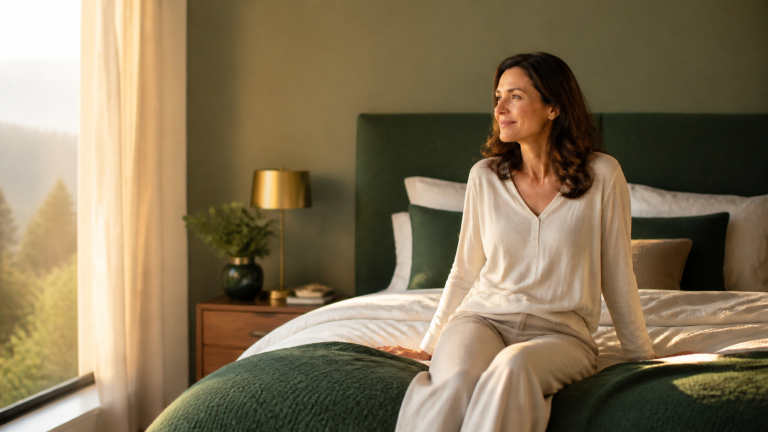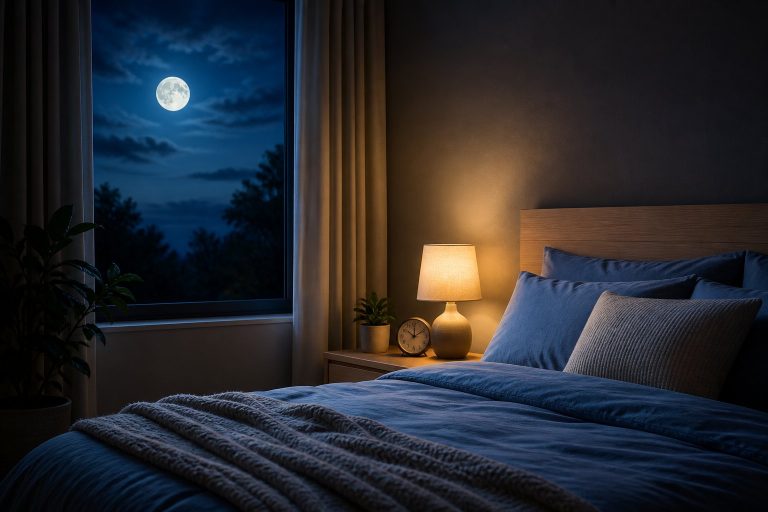
Morning sunlight and circadian rhythm are tightly connected. Light entering the eyes after waking is one of the strongest signals that helps the brain distinguish biological day from night. A well-timed morning light routine may support earlier alertness, a steadier sleep schedule, and stronger sleepiness at night—but the right timing depends on your current body clock and lifestyle.
This evidence-based guide explains how morning light affects circadian timing, how much exposure may be practical, what to do on cloudy days, and when bright-light therapy requires professional guidance.
What Is the Circadian Rhythm?
The circadian rhythm is an approximately 24-hour biological timing system. It helps coordinate sleep and wakefulness, body temperature, hormone release, digestion, alertness, and many other processes. The master clock in the brain receives information about environmental light through the eyes and uses it to synchronize the body with the outside day.
Light is often described as the dominant environmental “zeitgeber,” or time cue. Meals, movement, social activity, and temperature also provide timing information, but light generally has the strongest direct effect on the central circadian clock.
How Morning Sunlight and Circadian Rhythm Work Together
Light exposure produces different effects depending on biological timing. For many people who sleep at night and wake in the morning, bright light shortly after waking tends to shift the clock earlier. This can make it easier to feel alert earlier in the day and sleepy earlier in the evening.
Bright evening and nighttime light often pushes circadian timing later. A systematic review of light exposure and sleep found that brighter morning light was associated with earlier sleep timing and better self-reported sleep, while brighter evening light was associated with later timing and worse self-reported sleep.
Key principle: seek brighter days and dimmer evenings. The contrast between daytime and nighttime light is often more useful than obsessing over one exact lux number.

What Happens to Melatonin?
Melatonin is a nighttime timing signal produced by the body. Levels usually rise in dim evening conditions, stay elevated during the night, and fall toward morning. Morning light helps reinforce daytime alertness and the timing of the next night’s melatonin rhythm.
It is misleading to say that morning sunlight “creates” melatonin for the night in a simple dose-for-dose way. Circadian biology is more complex. Timing, intensity, duration, prior light exposure, and individual sensitivity all influence the response.
If you are considering a supplement, see our evidence-based article on melatonin and sleep. Supplemental melatonin and morning light are timing tools, not interchangeable sedatives.
Benefits of Morning Sunlight and Circadian Rhythm Alignment
Earlier daytime alertness
Bright morning light can have an immediate alerting effect and may help reduce sleep inertia. Pairing light exposure with gentle movement can make the transition to wakefulness easier.
A more consistent sleep schedule
Morning light works best when combined with a consistent wake time. Together, these signals tell the brain when the active day begins and can reduce drift toward progressively later bedtimes.
Support for delayed sleep timing
People with delayed sleep-wake phase disorder fall asleep and wake much later than desired. Morning light therapy is one clinical tool used to shift timing earlier, often in combination with carefully scheduled dim light in the evening and sometimes melatonin. Because incorrect timing can worsen the problem, professional guidance is valuable.
Mood and seasonal patterns
Bright-light therapy is used clinically for seasonal affective disorder and has been studied for other mood conditions. Treatment devices, timing, intensity, and duration should be chosen with a qualified professional, particularly for people with bipolar disorder or eye conditions.
Morning Sunlight and Circadian Rhythm: How Much Light?
There is no universal number of minutes that works for everyone. Outdoor light intensity changes dramatically with season, latitude, cloud cover, shade, air quality, time of day, and surroundings. Individual circadian timing and eye sensitivity also matter.
A practical starting routine for many healthy adults is to go outdoors within the first hour after waking and spend roughly 10 to 30 minutes in daylight. On dark, cloudy, or winter mornings, longer exposure may be needed. This is a practical habit—not a medically established prescription.
You do not need to look directly at the sun. Simply being outdoors with the sky in your field of view provides much more light than most indoor environments. Direct sun-gazing can injure the eyes and should be avoided.
Morning Sunlight and Circadian Rhythm Through a Window
Window light can be brighter than ordinary indoor lighting and may help, but outdoor exposure is usually more powerful. Glass, window size, building orientation, shade, distance from the window, and indoor layout reduce or alter the available light.
If going outside is not practical, sit close to a bright window while eating breakfast or planning the day. Treat this as a useful backup, not necessarily an equal replacement for outdoor daylight.
Morning Sunlight and Circadian Rhythm on Cloudy Days
Outdoor daylight is often much brighter than indoor light even when the sky is overcast. Dress for the weather and use a covered balcony, porch, or short walk if conditions are safe.
At high latitudes or during very dark winters, a properly designed light box may be helpful. Light boxes are not the same as decorative lamps. Follow manufacturer safety instructions and seek guidance if you have bipolar disorder, migraine sensitivity, retinal disease, or use medicines that increase light sensitivity.
Morning Sunlight and Circadian Rhythm for Shift Workers
Standard morning-light advice does not always apply to night-shift workers. Light after a night shift can make it harder to sleep during the day, while bright light during the work period may support alertness and adaptation.
Shift-work plans can involve timed bright light, dark sunglasses during the commute home, a dark bedroom, and scheduled sleep. The correct approach depends on whether the shift is permanent, rotating, or temporary. A sleep specialist can design a safer plan.
Morning Sunlight and Circadian Rhythm Need a Consistent Wake Time
Morning sunlight works as part of a pattern. Set a wake time you can maintain most days, open curtains immediately, and move toward outdoor light. Large weekend sleep-ins may reduce the consistency of this signal.
A systematic review of sleep timing and regularity found that later and more variable schedules were generally associated with less favorable health outcomes, although evidence quality ranged from very low to moderate. Consistency matters without requiring rigid perfection.
Support Circadian Rhythm With Movement and Breakfast
A brief walk adds physical activity and may increase alertness. Breakfast can also serve as a secondary timing cue, especially when meal timing is stable. Morning light remains the stronger circadian signal, so do not assume coffee or breakfast replaces it.
If you are not hungry early, there is no need to force a large meal solely for circadian reasons. Focus on a consistent pattern that fits your health needs.
Protect Your Circadian Rhythm in the Evening
Morning light sends a stronger signal when evenings are relatively dim. During the last one to two hours before bed:
- Lower overhead lighting
- Reduce screen brightness and avoid holding bright devices close to the face
- Use warm, comfortable task lighting
- Keep the bedroom dark during sleep
- Avoid repeatedly turning on bright lights during nighttime awakenings
Blue-light-filtering glasses may help in selected situations, but research is inconsistent. Dimming the whole environment and changing behavior may be more reliable than relying on one product.
Morning Sunlight, Circadian Rhythm, and Deep Sleep
Morning light does not directly guarantee more stage 3 sleep. Its main role is to strengthen circadian timing and support a stable sleep window. Better alignment may improve the opportunity for normal sleep cycles, but deep sleep also depends on age, total sleep, exercise, alcohol, illness, medications, and sleep disorders.
For a broader plan, see our guide to deep sleep optimization, which covers sleep opportunity, exercise, the bedroom environment, and tracker limitations.
A Practical Morning Sunlight and Circadian Rhythm Routine
- Choose a consistent wake time: keep weekend variation modest.
- Open the environment: uncover windows and turn on indoor lights immediately.
- Go outside: aim for daylight within the first hour after waking.
- Start with 10–30 minutes: extend on dark or cloudy mornings as practical.
- Add gentle movement: walk, stretch, or sit outdoors with breakfast.
- Repeat daily: consistency matters more than one perfect morning.
- Dim the evening: create a clear contrast between day and night.
Morning Sunlight and Circadian Rhythm: Common Mistakes
- Looking directly at the sun: unnecessary and potentially harmful.
- Using bright light at the wrong biological time: it may shift the clock later instead of earlier.
- Ignoring evening light: a very bright late evening can compete with the morning signal.
- Expecting one day to fix months of irregular sleep: circadian change requires repetition.
- Using a light box without checking safety: certain eye, neurological, and mood conditions require caution.
- Chasing exact lux numbers from a phone: phone sensors are not reliable clinical light meters.
When to Seek Professional Guidance
Consult a healthcare or sleep professional if you have persistent difficulty falling asleep or waking at the desired time, severe daytime sleepiness, rotating-shift problems, bipolar disorder, an eye condition, or symptoms such as loud snoring and gasping.
Light therapy can cause eyestrain, headache, nausea, agitation, or sleep-timing changes. People with bipolar disorder may be at risk of mood activation. A clinician can help select timing, intensity, duration, and device quality.
Frequently Asked Questions
How soon after waking should I get morning sunlight?
For many daytime sleepers, within the first hour after waking is a practical target. The ideal timing varies with circadian phase and the direction of the desired shift.
Do I need sunlight, or is daylight enough?
Outdoor daylight is useful even without direct sun. You do not need a clear sky or direct rays on the face.
Can I wear glasses or contact lenses?
Ordinary clear lenses still allow substantial visible light, although transmission differs by lens. Dark sunglasses reduce light reaching the eyes; use them when needed for comfort and eye protection, not for sun-gazing.
Will morning sunlight cure insomnia?
No. It may strengthen circadian timing, but insomnia can involve conditioned arousal, anxiety, medical problems, medications, or sleep disorders. CBT-I is the first-line treatment for chronic insomnia.
Does morning sunlight provide vitamin D through a window?
This article concerns light signaling to the eyes, not vitamin D production in skin. Window glass blocks most UVB used for vitamin D synthesis, while visible light still contributes to circadian signaling.
The Bottom Line
Morning sunlight and circadian rhythm work together because early-day light helps tell the brain when biological daytime begins. A simple routine—consistent waking, outdoor daylight, morning movement, and dimmer evenings—can strengthen sleep timing without expensive technology. Avoid direct sun-gazing, adjust for shift work and individual health, and seek professional guidance for persistent sleep or mood problems.
This article is for educational purposes only and is not a substitute for medical advice, diagnosis, or treatment.
Sources
- National Institute of Neurological Disorders and Stroke: Understanding Sleep
- Dautovich ND, et al. Amount and timing of light in association with sleep outcomes: systematic review (2019)
- Böhmer MN, et al. Daily light exposure, sleep-wake rhythm, and mood: systematic review (2021)
- van Maanen A, et al. Light therapies to improve sleep: systematic review and meta-analysis (2019)
- Chaput JP, et al. Sleep timing, sleep consistency, and health in adults: systematic review (2020)
- Shechter A, et al. Reducing short-wavelength light at night and sleep: systematic review and meta-analysis