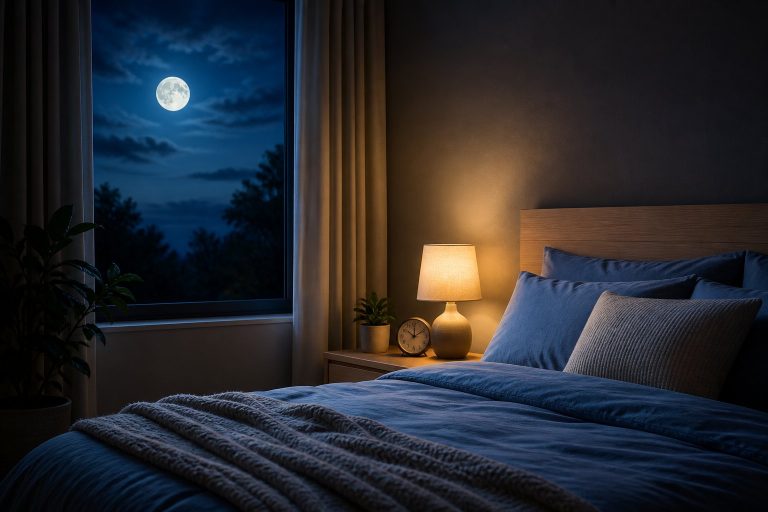
Nighttime routines for better sleep work by reducing stimulation, creating predictable cues, and making healthy sleep behavior easier to repeat. A routine does not need to be elaborate or perfectly optimized. The most effective version is usually simple, calming, and consistent enough to survive busy evenings.
This evidence-based guide shows how to build a realistic 30- to 60-minute wind-down routine, which habits matter most, and when bedtime tips are not enough to treat an ongoing sleep problem.
Why Nighttime Routines for Better Sleep Can Help
The brain learns from repeated patterns. When the same quiet activities happen in the same order before bed, they can become signals that the active day is ending. A routine also creates practical boundaries around work, entertainment, eating, and screen use.
Sleep hygiene includes behavioral and environmental factors such as caffeine, alcohol, exercise, sleep timing, light, noise, temperature, stress, and stimulus control. These factors are relevant, but sleep hygiene alone is not equivalent to a full treatment for insomnia.
Important distinction: a bedtime routine supports healthy sleep. Chronic insomnia often requires cognitive behavioral therapy for insomnia (CBT-I), which has a stronger evidence base than sleep-hygiene education alone.
Start With a Consistent Wake Time
A better night often begins in the morning. A regular wake time anchors the daily schedule and makes sleep pressure more predictable by evening. Try to keep weekend variation modest rather than shifting the entire schedule by several hours.
Morning daylight adds a strong circadian signal. Our guide to morning sunlight and circadian rhythm explains practical timing, cloudy-day options, and safety.
Choose a Realistic Bedtime Window
Do not choose bedtime only by counting backward from an ideal number. Consider when you genuinely become sleepy, how much sleep you need, and when you must wake. Going to bed much earlier than your natural sleepiness can lead to long periods of frustrated wakefulness.
Create enough opportunity for at least seven hours of sleep for most adults, while recognizing that individual needs vary. If bedtime changes, shift gradually rather than forcing a dramatic change in one night.
A 60-Minute Nighttime Routine for Better Sleep
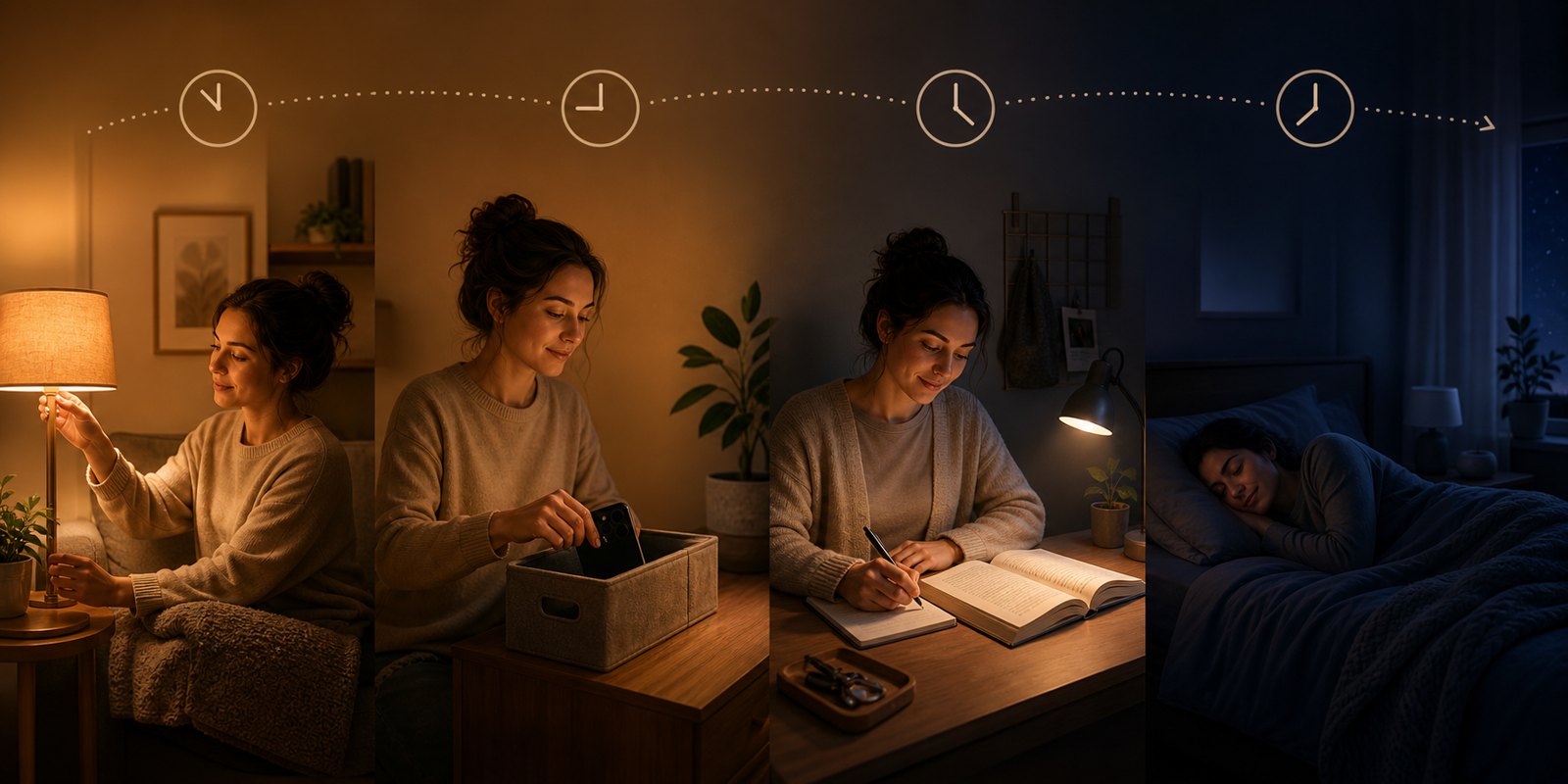
60 minutes before bed: close the active day
End work, difficult planning, and stimulating entertainment. Write down unfinished tasks and the first step for tomorrow. This reduces the need to rehearse responsibilities in bed.
45 minutes before bed: dim the environment
Lower overhead lights and use comfortable task lighting. Reduce screen brightness and avoid holding a bright device close to the face. Evening dimness supports the body’s transition toward biological night.
30 minutes before bed: complete practical tasks
Prepare clothing, medications already prescribed for your schedule, water, and anything needed in the morning. Brush your teeth and complete personal care before you are extremely tired.
15 minutes before bed: choose one calming activity
Read a paper book, listen to quiet music, practice gentle stretching, or use slow breathing. The goal is not to force sleep but to reduce stimulation and let sleepiness emerge.
At bedtime: enter a dark, quiet room
Go to bed when sleepy. Keep the room dark, quiet, and comfortable. If you remain awake and frustrated for a prolonged period, briefly leave the bed and return when sleepy rather than training the brain to associate bed with struggle.
Nighttime Routines for Better Sleep and Screen Use
“No screens after sunset” is unrealistic for many people. A more sustainable approach is to reduce both light and emotional stimulation. Use a lower brightness, enable a warmer display setting, avoid highly engaging content, and set a clear stopping point.
Blue-light filters are not a complete solution. Screen content can keep the mind alert even when color temperature changes. The whole environment—room lighting, viewing distance, brightness, and behavior—matters.
Nighttime Routines for Better Sleep and Less Worry
Bedtime often becomes the first quiet moment of the day, allowing worries to become louder. Schedule a 10- to 15-minute “worry period” earlier in the evening. Write concerns down, separate solvable problems from uncertainties, and list one next action for each solvable item.
If thoughts return in bed, remind yourself that the issue has been recorded. Avoid trying to solve major personal or work problems while lying awake.
Relaxation in Nighttime Routines for Better Sleep
Slow breathing, progressive muscle relaxation, mindfulness, and gentle stretching can lower arousal for some people. They should be practiced as ways to rest—not as tests you must pass to make sleep happen.
If you become more frustrated while monitoring whether a technique is “working,” switch to a neutral activity. Paradoxically, trying too hard to sleep can increase alertness.
Nighttime Routines for Better Sleep Need the Right Bedroom
A good routine ends in an environment that protects sleep:
- Dark: use curtains, cover distracting lights, or try a comfortable eye mask.
- Quiet: reduce intermittent noise; steady background sound may mask unavoidable disruption.
- Comfortable: select bedding that does not cause overheating or pain.
- Cool: avoid a room that feels hot or stuffy.
- Low-distraction: silence nonessential alerts and keep work materials away from bed.
If nighttime awakenings are frequent, optimizing the environment may support more continuous sleep cycles. See our article on deep sleep optimization for a broader discussion of sleep architecture and tracker limitations.
Time Caffeine Earlier
Caffeine can remain active for many hours. Sensitivity varies, so a universal cutoff is not realistic. If sleep onset or nighttime waking is a problem, move the last caffeine earlier for two weeks and observe the pattern.
Remember that coffee is not the only source. Tea, energy drinks, pre-workout products, chocolate, and some medicines may contain caffeine.
Avoid Using Alcohol as a Sleep Aid
Alcohol can make people feel sleepy initially, but it often fragments sleep later in the night and alters normal sleep architecture. It may worsen snoring, reflux, and obstructive sleep apnea.
A calming ritual should not depend on alcohol. Choose a noncaffeinated drink that fits your health needs, without assuming a particular tea has a proven sedative effect.
Plan Food and Fluids
A very large, rich, or spicy late meal may cause discomfort or reflux. Excess fluid close to bed can increase bathroom trips. At the same time, going to bed extremely hungry may keep some people awake.
Finish the main meal earlier when possible. If needed, choose a modest snack rather than turning the bedtime routine into a second dinner. People with diabetes, reflux, kidney disease, or other medical conditions should follow individualized guidance.
Exercise During the Day
Regular physical activity supports sleep and overall health. The best exercise time is the time you can sustain without disrupting your own sleep. Many people tolerate evening exercise well, but a very intense session ending close to bedtime may keep some individuals alert or overheated.
Gentle evening stretching is different from a demanding workout. Use your response over multiple nights rather than one tracker score to judge timing.
Should You Take a Warm Shower or Bath?
A warm shower or bath can be a pleasant transition from the day. It may support relaxation and the normal drop in core body temperature that accompanies sleep onset. Keep the water comfortable rather than excessively hot.
The ritual matters as much as the exact temperature. If bathing energizes you or delays bedtime, move it earlier or choose another cue.
Reading, Music, and Audio
Choose content that is calming but not so engaging that you ignore bedtime. Paper books or e-readers with dim, warm lighting may be easier to manage than bright multipurpose devices.
Music, audiobooks, or podcasts can help if they do not require continuous interaction. Use a sleep timer and keep volume low enough to protect hearing.
Nighttime Routines for Better Sleep When You Have Children
Family routines require flexibility. Prepare key items earlier, share responsibilities when possible, and focus on two or three repeatable cues instead of a perfect hour-long ritual.
Parents may benefit from a short “second wind-down” after children are asleep: dim lights, prepare for tomorrow, and choose one calming activity. The routine should reduce workload rather than add another standard to meet.
Nighttime Routines for Better Sleep While Traveling
Use portable cues: the same reading material, eye mask, short breathing exercise, and familiar audio. Keep the destination’s local wake time in mind and use light strategically.
For jet lag, bedtime routine alone may not reset circadian timing. Morning or evening light and, in selected cases, appropriately timed melatonin may be relevant.
What to Do If You Wake During the Night
Keep lights low and avoid checking the clock repeatedly. If you are comfortable and calm, resting quietly may be enough. If you become alert and frustrated for a prolonged period, get out of bed and do a quiet activity in dim light until sleepiness returns.
Do not compensate for every poor night with an extremely early bedtime or a long late nap. Protect the regular wake time when it is safe to do so.
Common Nighttime Routine Mistakes
- Making the routine so complicated that it cannot be repeated
- Starting only after becoming overtired
- Expecting one product or supplement to create sleep
- Checking sleep-tracker data during the night
- Using the bed for work, arguments, or prolonged scrolling
- Going to bed hours before genuine sleepiness
- Treating one imperfect evening as failure
A Minimal 20-Minute Nighttime Routine for Better Sleep
On a busy night, use a condensed version:
- Five minutes: write tomorrow’s priorities and close work.
- Five minutes: complete hygiene and prepare the room.
- Five minutes: dim lights and put the phone on charge away from the bed.
- Five minutes: read, stretch gently, or practice slow breathing.
A short routine repeated consistently is more useful than an impressive routine performed twice.
How to Evaluate Nighttime Routines for Better Sleep
Track a few simple measures for two weeks: routine start time, bedtime, estimated sleep onset, nighttime awakenings, wake time, and daytime alertness. Avoid changing five variables at once.
Look for trends, not perfection. A useful routine should feel easier over time, fit your life, and support daytime function. Wearable sleep stages are estimates and should not be the only measure of success.
When Nighttime Routines Are Not Enough
Seek professional help when poor sleep persists for months, causes significant daytime impairment, or occurs with loud snoring, gasping, severe sleepiness, restless legs, pain, depression, anxiety, or medication changes.
For chronic insomnia, CBT-I combines cognitive strategies, stimulus control, sleep scheduling, and other techniques. A 2025 meta-analysis found that sleep-hygiene education can improve insomnia symptoms, but it was less effective than CBT-I and several other structured interventions.
Frequently Asked Questions
How long should a nighttime routine be?
Many people do well with 30 to 60 minutes, but even 15 to 20 minutes can work if it is consistent. The routine should fit your schedule rather than reduce total sleep time.
Should I go to bed at exactly the same time?
Consistency helps, but use a reasonable window and pay attention to sleepiness. A stable wake time is often the stronger anchor.
What is the best relaxing activity?
There is no universal best choice. Reading, quiet music, stretching, breathing, or a warm shower can all be reasonable if they feel calming and are easy to repeat.
Can supplements replace a routine?
No. Supplements do not correct late caffeine, bright light, an irregular schedule, or untreated sleep disorders. They may also cause side effects and interactions.
The Bottom Line
Nighttime routines for better sleep should lower stimulation, close the active day, and lead into a dark, quiet, comfortable bedroom. Start with a consistent wake time, dim the evening, move caffeine earlier, and select one or two calming activities. Keep the routine simple enough to repeat—and seek evidence-based treatment when sleep problems persist.
This article is for educational purposes only and is not a substitute for medical advice, diagnosis, or treatment.
Sources
- National Heart, Lung, and Blood Institute: Healthy Sleep Habits
- National Heart, Lung, and Blood Institute: Insomnia Treatment
- Ruan JY, et al. Effects of sleep hygiene education for insomnia: systematic review and meta-analysis (2025)
- Edinger JD, et al. Behavioral and psychological treatments for chronic insomnia: AASM systematic review (2021)
- Mead MP, et al. Sleep hygiene—What do we mean? A bibliographic review (2024)
- Chaput JP, et al. Sleep timing, sleep consistency, and health in adults: systematic review (2020)